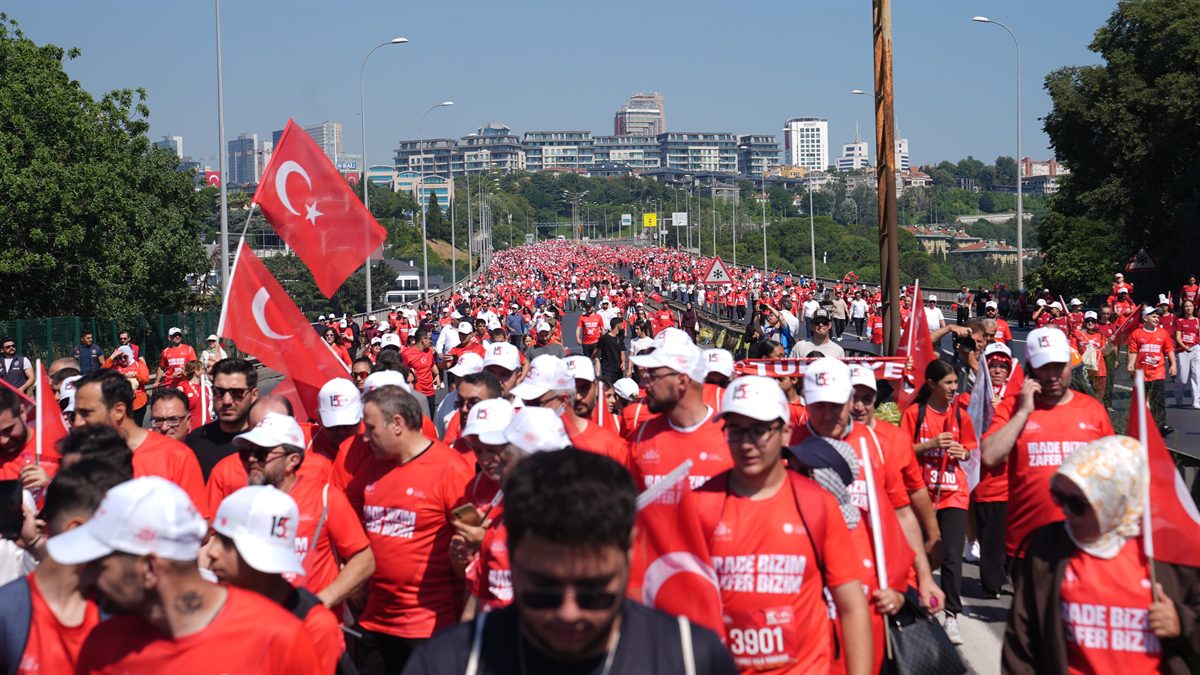
On the July 15 Martyrs' Bridge, the span where soldiers once pointed their rifles at the traffic, crowds walked across it again on Wednesday behind one banner: İrade Bizim, Zafer Bizim. The will is ours, the victory is ours.
Ten years to the day since a faction of the army tried to seize Türkiye and failed, the country spent Democracy and National Unity Day doing what it has done every 15 July since 2016, only bigger. The Presidency's Directorate of Communications ran the bridge march. Ceremonies filled all 81 provinces. And the state's whole top tier put out its account of the night in more or less the same words.
President Recep Tayyip Erdoğan set the tone. He called July 15 "a great victory for democracy, written in golden letters in history," the day the nation defended its will, its democracy, and its independence at the cost of its life.
Vice President Cevdet Yılmaz took the message to the July 15 Martyrs' Monument, then put it in writing on the Turkish platform NSosyal. The people who "filled the squares at the call of our President," he wrote, "defended their homeland, flag and democracy at the cost of their lives, displaying one of the most glorious acts of resistance in our history." He tied the decade to the government's Century of Türkiye program and to what he called a determination to build a future free of terrorism.
Communications Director Burhanettin Duran called the night a turning point that secured Türkiye's future and its democratic path, one that showed the world no force can override the national will. First Lady Emine Erdoğan called the defeated coup "the name of the resistance that rose from the homeland, and of unshakable courage." More than 250 people were killed that night, most of them civilians who went out unarmed against tanks.
The commemorations run on memory by design. The Hafıza 15 Temmuz Museum, built after the coup, has now drawn close to 3 million visitors in seven years, according to Anadolu Ajansı. Anadolu marked the anniversary with a 356-page book, "July 15: Witnesses and Confessions," that sets the events of the night against court testimony from convicted FETÖ members, the network Ankara holds responsible for the plot.
That reckoning is the part the day does not settle. In Edirne, on the western border, security forces say they have caught 5,033 FETÖ suspects trying to slip across into Greece since the night of the coup, among them senior figures and dismissed officials. Ten years in, the trials begun in 2016 are still producing arrests.
The anniversary also revived an old grievance with Washington. Serdar Kılıç, Türkiye's ambassador to the United States on the night of the coup, told Anadolu Ajansı that the Obama administration was too slow to stand by an ally. It waited four days to explicitly condemn the attempt, he said, and Secretary of State John Kerry's first response spoke of restraint. Kılıç said he was told a supporting statement was waiting on a president no one could reach in the Situation Room. "I saw an attitude that was incompatible with the relationship that should exist between two allies," he said.
Foreign Minister Hakan Fidan framed the anniversary as unfinished work. Türkiye is still moving to keep FETÖ-like groups from burrowing back into state institutions, he said, speaking before he left for talks in Kyiv, and he described the organization itself as a structure whose usefulness has now run out. Whatever the group was on the night it tried to take the country, a decade of prosecutions has left it, in Ankara's telling, spent.