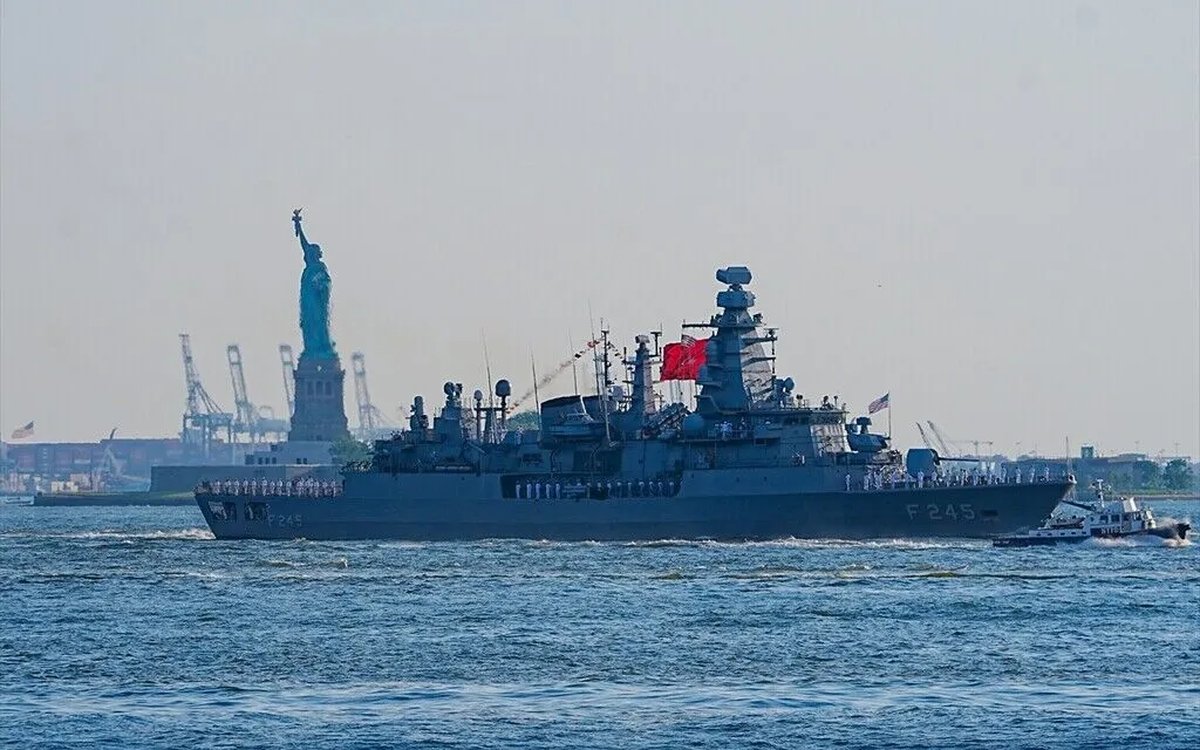
A Turkish warship spent America's birthday on the Hudson. The TCG Oruçreis anchored in New York Harbor for the United States' 250th anniversary, joining an international naval review among warships from a dozen navies. One gray hull among many, a small and ceremonial thing. It is also the latest line in a story that runs back almost two centuries, and that has survived far worse than a disagreement.
The beginning, 1830
The relationship is older than most of the alliances Washington now takes for granted. The Ottoman Empire and the young American republic recognized each other in 1830 and concluded a treaty of commerce and navigation that year; the first American legation opened in the Ottoman capital in 1831. American merchants had worked the Ottoman Levant for decades, and a republic barely half a century old was putting ties with an empire on paper.
The alliance, forged in the Cold War
The modern alliance came later, and under Soviet pressure. The United States recognized the Republic of Türkiye, founded in 1923, and the two restored full diplomatic relations in 1927. When Moscow leaned on Ankara after the Second World War, the Truman Doctrine of 1947 sent American aid to Türkiye and Greece. In 1952 Türkiye joined NATO, and the alliance gained its southeastern anchor: a large army on the Soviet frontier, the air base at İncirlik, and a hand on the straits.
That anchor cut both ways. When the Cuban Missile Crisis was settled in 1962, part of the quiet bargain was the removal of American Jupiter missiles from Turkish soil. Türkiye has spent the decades since as an indispensable and occasionally inconvenient ally, the kind that hosts the base and asks what it is getting in return.
The quarrels
And the quarrels have been real, and old.
The first great rupture came in 1964, when President Lyndon Johnson wrote to Prime Minister İnönü warning Türkiye against intervening in Cyprus, and adding that NATO might not defend it from the Soviet Union if it did. Ankara read it as a threat from its own ally. The quarrel turned material a decade later: after Türkiye's 1974 intervention in Cyprus, the United States imposed an arms embargo that ran from 1975 to 1978, cut Ankara off from American weapons, and, more than any speech, convinced it to build a defense industry of its own. In 2003 the pressure ran the other way, when the Turkish parliament refused to let American troops open a northern front into Iraq through Türkiye, a refusal Washington did not forget.
The recent quarrels are sharper. Four stand out.
The coup and the cleric. When a faction of the military tried to seize the country on 15 July 2016, Ankara watched Washington hesitate. The Obama administration took four days to explicitly condemn the attempt, and Secretary of State John Kerry's first response spoke of restraint. Serdar Kılıç, Türkiye's ambassador in Washington that night, said he was told a supporting statement was waiting on a president no one could reach in the Situation Room. Worse was what came after: the man Ankara blamed for the plot, the cleric Fetullah Gülen, lived out his years in Pennsylvania, and every Turkish request to extradite him failed, until he died there in 2024, beyond the reach of a Turkish court.
Washington and the opposition. In an interview with the New York Times editorial board in December 2019, Joe Biden, then a candidate for the presidency, called President Erdoğan an "autocrat" and urged Washington to embolden the Turkish opposition to defeat him at the ballot box. A video of the remarks circulated widely in Türkiye when it resurfaced in August 2020, and the Directorate of Communications condemned it as an "interventionist approach" and interference in Türkiye's domestic politics. Even Turkish opposition figures rejected it. Biden went on to win the White House, and the remarks kept drawing objections from Turkish officials.
Arming the PKK's Syrian branch. For years the United States armed and trained the Syrian Democratic Forces, the militia led by the YPG, the PKK's Syrian affiliate, as its ground partner against Daesh (ISIS). Washington called the YPG a separate force. Ankara called it the United States handing weapons to the Syrian branch of a group that kills Turkish soldiers and civilians, and the grievance has outlasted the war that produced it. American officials said as much on the record: the Pentagon acknowledged the PKK tie in the Senate, and the special-operations commander later described renaming the group himself.
The S-400 and the F-35. In 2019 Türkiye took delivery of the Russian S-400 air-defense system. Washington removed it from the F-35 program and imposed CAATSA sanctions on Türkiye's defense-procurement agency. The engines for the KAAN fighter and a possible return to the F-35 are still on the table between the two governments.
Still allied
None of it broke the alliance. Türkiye remains a NATO member with the second-largest military in the pact, and this week it hosts the alliance's summit in Ankara, the first time in 22 years. Its defense industry now sells into NATO itself: Turkish combat software went aboard a Romanian warship this month. The two governments still call each other strategic partners, and still mean it, because each needs the other more than either likes to admit. Türkiye sits where three regions meet; the United States is the alliance's indispensable power. Geography wrote the partnership before politics could unwrite it.
So the Oruçreis on the Hudson carries more than ceremony. It is a reminder that two republics, one turning 250 and one nearing its own second century, have spent almost two hundred years disagreeing loudly and staying allied anyway. The argument is how this alliance has always worked.