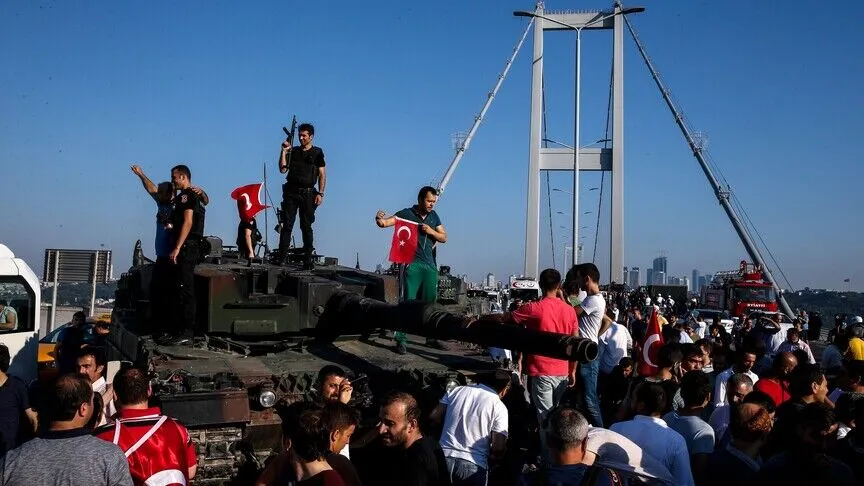
The first sign, for most people, was the bridges.
On the night of 15 July 2016, soldiers closed the two spans across the Bosphorus and stood with their rifles facing the traffic. Tanks rolled onto the runways at İstanbul's airport. Low over Ankara, fighter jets crossed and recrossed the city so fast and so loud that windows shook, and twice in the dark they put bombs into the Grand National Assembly, the parliament of the Republic, while lawmakers refused to leave the chamber. A faction of the Turkish Armed Forces, calling itself the Peace at Home Council, was trying to take the country by force.
It did not take it. By the morning of the 16th the coup was broken, and the reason it broke is the thing Türkiye has spent ten years marking. People went into the streets. Unarmed, in the middle of the night, they walked toward the tanks, and enough of them did it that the soldiers who had bet on a frightened, sleeping nation found a waking, furious one instead. It cost them. That night killed 253 people and wounded more than 2,000, most of them civilians who owned no weapon heavier than a phone.
The phone mattered. President Recep Tayyip Erdoğan was on holiday in Marmaris when the tanks moved, cut off from the capital, and he reached the country the only way left to him, a video call held up to a camera on CNN Türk, telling people to go out and reclaim the squares. Mosques opened their minarets and called the sela, the summons usually reserved for a death, through the night. The images from those hours, a man in a suit lying under a tank on the bridge, a crowd swallowing an armored vehicle, are the ones the country has kept.
What it was
The plot ran through the military but not from it. Ankara holds that the network behind it was FETÖ, the Fetullahist Terror Organization, built over decades by the cleric Fetullah Gülen from a religious movement into something with its own people inside the state, and that these officers were its hand on the trigger. The command post that night was the Akıncı air base outside Ankara, where the plotters held the chief of the general staff, Hulusi Akar, until special forces took the base back and freed him. The state broadcaster TRT was seized too, and an announcer was made to read the putsch's declaration on air before the studio was retaken.
The bridge where the soldiers had stood carries the memory in its name now. Within days the cabinet renamed the Bosphorus Bridge the 15 Temmuz Şehitler Köprüsü, the July 15 Martyrs' Bridge, and a monument, a museum and a mosque went up near its Anatolian end. It is a strange and deliberate thing, to name the scene of a killing after the killed and then keep driving across it every day, and it is characteristic of how Türkiye chose to hold this night, as a date to be repeated rather than a wound to be hidden.
The hinge
A night became a national day faster than almost any event in modern memory. That October, ten weeks after the coup, Türkiye made 15 July a public holiday, Democracy and National Unity Day, and it has been marked every year since with ceremonies run out of the Presidency, with vigils the state calls the democracy watch, and with a school calendar that plants memorial groves and reads the names of the dead. A study published by Cambridge University Press has traced how quickly and how completely the commemoration was assembled, the invention of a new national holiday almost in real time.
The museums followed. Erdoğan opened the July 15 Democracy Museum in Ankara on the fifth anniversary, across from the Presidential Complex, and it has drawn well over a hundred thousand visitors; a second museum stands at Kahramankazan, near the Akıncı base. Ten years on, the anniversary has grown into television drama and documentary and a state program that runs across all 81 provinces. A country decided that the way to make sure the night could not be repeated was to refuse to let it be forgotten, and it has spent a decade building the machinery of that refusal.
The decade of reckoning
The other half of the story is harder, and an honest account of the ten years cannot leave it out. The morning the coup broke, the state moved against the network it blamed, and it moved at a scale the Republic had not seen. On 20 July 2016 Türkiye declared a state of emergency that would run, renewed every three months, until July 2018, two full years, and governed much of that period by decree.
The numbers are large and they are not really disputed. Over the emergency, more than 130,000 public officials were dismissed from their posts. Among them were some 3,400 judges and prosecutors, close to a fifth of the judiciary. The first decree, days after the coup, shut 1,043 private schools, 15 universities, over a thousand charities and foundations, dozens of trade unions and medical institutions in a single stroke. These figures come from the reckonings of Western human-rights and legal bodies, Human Rights Watch, the Venice Commission of the Council of Europe, the International Commission of Jurists, the US State Department, and while those bodies frame what they counted as a collapse of the rule of law, the counting itself is sound.
Ankara's account of why is a different account, and it belongs here in its own terms. The case the Turkish state makes is that FETÖ was not a normal conspiracy that could be pulled out by a dozen arrests. It was, in this telling, a clandestine organization that had spent thirty years placing its people, quietly, patiently, inside the courts, the police, the armed forces, the universities and the schools, precisely so that it could one day do what it tried to do on 15 July. To root out a network built that way, the argument goes, meant reaching into all of those institutions at once, because that was where it had put itself. That is the logic behind the scale.
Whether every dismissal was just is a separate question, and the fairer answer is that many were and some were not. Türkiye's own institutions have said as much: a commission was set up to review the emergency dismissals, and it has reinstated a share of those who were removed, which is both an admission that the net caught people it should not have and evidence that there was a process to catch the error. A response this wide does not come without cost to the innocent, and it does not help the country's case to pretend it was surgical. It was not. It was a state, badly frightened by how close it had come to falling, acting on the belief that the danger ran deeper than the officers on the bridges.
The reckoning has not closed. Ten years on, prosecutors were still issuing arrest warrants in 2025 for people accused of FETÖ ties inside the military, which tells you that Türkiye does not consider the account settled, and that the trials begun in 2016 have outlasted the decade.
The man who died in exile
At the center of all of it was a man who was never in the country for any of it. Fetullah Gülen spent the last quarter-century of his life in a gated compound in the Pocono Mountains of Pennsylvania, and Türkiye's long campaign to have the United States extradite him, to answer in a Turkish court for the night it blames on his network, never succeeded. He denied to the end that he had ordered the coup. Then, on 20 October 2024, he died there, at 83, in an American hospital.
His death drew a line under something without resolving it. The man Ankara held responsible for 15 July will now never stand trial in Türkiye, never be convicted or cleared in the courts of the country he is accused of trying to overthrow. The case against him, in his person, is closed by nature rather than by verdict. For a state that built museums and a national holiday around the certainty of what happened that night, the fact that its central defendant died beyond its reach is the one part of the story it could not stage.
Ten years on
So what did the night settle, and what did it not?
It settled that the Turkish army would not take the country the way it had taken it, or tried to, four times in the second half of the last century. The generation that went into the streets on 15 July did something the country had not managed before, which was to stop a coup with its own body, and Türkiye has spent ten years making sure that generation and that fact are remembered. Whatever else is argued about the decade, the resistance itself was real, and 253 people did not go home.
What it did not settle is quieter and still open. The decade the night opened was one of emergency rule and mass dismissal and trials that are still running, of a reckoning wide enough to catch the guilty and some of the innocent both, and of a central figure who slipped the country's grasp and died an ocean away. A nation can honor the courage of a night and still be living, ten years later, inside the long and unfinished argument about everything that came after. Türkiye is doing both at once, and on 15 July it does them in the same squares, under the same flags, in the shadow of a bridge that now carries the name of the people who died holding it.