The Explainer
What NATO 3.0 means
Anadolu Ajansı frames the alliance's evolution in three phases. NATO 1.0 was the Cold War compact, built on collective defense and the Article 5 guarantee. NATO 2.0 was the quieter era after 1989, when the alliance turned outward to crisis management and out-of-area missions, the posture on show when Türkiye last hosted a summit, in Istanbul in 2004. NATO 3.0 is the return to hard deterrence as the threat from Russia sharpens again, with European members asked to carry more of the conventional burden while the United States keeps the strategic lead and looks increasingly to the Pacific.
A Western wire reads the moment much the same way. The Associated Press casts the Ankara meeting as a turning point for the alliance, coming as the United States steps back from its traditional security role in Europe.
The through line for Türkiye is that this shift raises its weight rather than lowering it. In 2004 Türkiye mattered mainly for geography and its front-line role. It arrives in 2026 as a defense-industry producer with a workforce of tens of thousands of engineers and firms exporting across the alliance, and as a multi-directional actor across the Black Sea, the Mediterranean, the Caucasus and the Middle East. The summit's own agenda, delivering on the spending commitments made at The Hague, widening defense-industrial production, and sustaining support for Ukraine, runs through Ankara's strengths.
Live
Summit developments
- 8 July The summit closes with the Ankara Summit Declaration. The allies reaffirm their "ironclad commitment" to Article 5 and collective defense, name Russia a long-term threat and terrorism a persistent one, announce more than $50 billion in new joint procurements, and pledge €70 billion ($80 billion) in military support to Ukraine for 2026 with at least as much to follow in 2027. They insist Iran "must never have a nuclear weapon" and demand freedom of navigation in the Strait of Hormuz, then thank Türkiye for hosting. (AA)
- 8 July The UK and Türkiye sign a new security and defense partnership on the summit sidelines, deepening cooperation on deterrence, defense industry, cyber and counter-terrorism, and pledging to "shoulder greater responsibility for building a stronger Europe in a stronger NATO." (AA)
- 8 July Türkiye's ambassador to Syria, Nuh Yilmaz, urges NATO allies to use their leverage to pressure Israel, whose constant occupation of Syrian territory, he says, is deepening the country's every crisis. (AA)
- 8 July Türkiye, Romania and Bulgaria sign an amendment to their trilateral Black Sea mine-countermeasures group on the summit sidelines, extending the three littoral allies' joint clearance of drifting sea mines. (AA)
- 8 July Poland's foreign minister urges allies to deepen cooperation as the summit's second day opens, pointing to closer Ankara-Warsaw defense ties. (AA)
- 8 July Belgium says it will prioritize air defense and drones as it lifts spending under the alliance's higher targets. (AA)
- 7 July As the US-Iran ceasefire collapses into fresh strikes, Trump uses the summit to criticize NATO allies who declined to back Washington during the Iran conflict, questioning why the United States carries the alliance if members will not stand with it. (AJ)
- 7 July On the summit sidelines, the UK's Starmer holds defense talks with his Dutch and Norwegian counterparts. (AA)
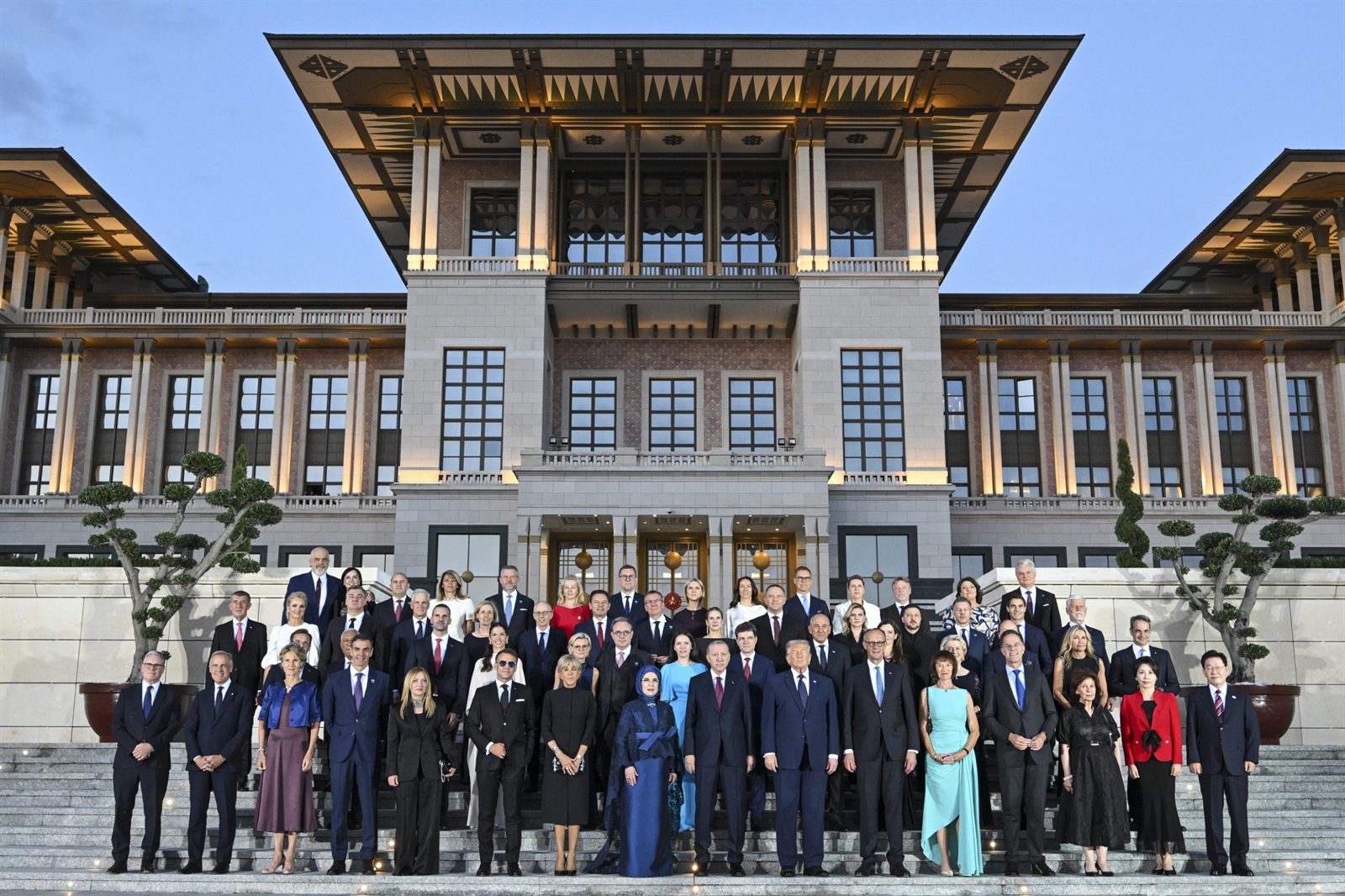
- 7 July The Mehter, the Ottoman military band, plays each NATO leader in at the Presidential Complex welcome. For Greek Prime Minister Mitsotakis and his wife it strikes up "Ceddin Deden," the corps' best-known march and a salute to Ottoman forebears; Trump, plainly taken with the performance, turns to the band and gives a thumbs-up. (NTV, Sözcü)
- 7 July Erdoğan hosts the visiting NATO leaders and their spouses at an evening reception and dinner at the Presidential Complex, closing the summit's first day. The leaders' working session and any declaration follow on 8 July. (AA)
- 7 July At a summit-sidelines panel in Ankara, Ukraine's foreign minister says Kyiv is ready for an "unconditional ceasefire" with Russia, on condition that any peace carry legally binding US security guarantees. Moscow had not responded by evening. (AA)
- 7 July NATO chief Rutte and the alliance's Indo-Pacific Four partners (Japan, South Korea, Australia, New Zealand) hold a joint meeting on the summit sidelines, agreeing to deepen cooperation on defense industry, cybersecurity and advanced technology; Japan's foreign minister calls European and Indo-Pacific security "inseparable." (AA)
- 7 July Beside Erdoğan, Trump says he will lift the CAATSA sanctions on Türkiye ("we don't want to sanction friends") and would "certainly consider" restoring its F-35 access; Erdoğan says he expects a "favorable decision" from the summit. (AA)
- 7 July Erdoğan welcomes Trump in Ankara, greeting him at Esenboğa Airport ahead of a welcome ceremony, bilateral talks, and a planned joint news conference at the Presidential Complex. (AA)
- 7 July Türkiye commits to procuring a significant number of ground-launched long-range Atmaca cruise missiles (Roketsan), NATO's deputy secretary general says at the Defense Industry Forum, within a low-cost cruise-missile and 155 mm ammunition effort valued at about $1.6 billion. (AA)
- 7 July Türkiye signs agreements at the Defense Industry Forum across five strategic areas (strike, air and missile defense, space and surveillance, critical raw materials, and UAV superiority), naming Aselsan, Roketsan, STM and TÜBİTAK. (AA)
- 7 July Rutte opens the summit with three multinational projects: an Airbus A400M and A330 tanker modernization, joint procurement of MQ-4C Triton surveillance drones, and up to 10 Swedish-made Saab GlobalEye aircraft to replace the alliance's aging AWACS fleet. (AA)
- 7 July NATO allies prepare to pledge €140 billion (about $160 billion) for Ukraine across 2026 and 2027, drawn from European and Canadian contributions, Germany's foreign minister says. (AA)
- 7 July Ukrainian President Volodymyr Zelenskyy arrives in Ankara for the summit, welcomed at Esenboğa Airport. (AA)
- 7 July European Commission President Ursula von der Leyen calls Türkiye "one of the largest armed forces within NATO," of "very big importance," and points to closer cooperation with EU defense initiatives, including the SAFE financing instrument, on a NATO-EU panel with Rutte. (AA)
- 7 July Allied ministers praise Türkiye's defense sector at the forum: Iceland's foreign minister calls its performance "exemplary" for NATO, and Australia's defense-industry minister points to new cooperation opportunities with a growing Turkish industry. (AA)
- 7 July ASELSAN is named among five firms on NATO's Modular Ground-Based Air Defense concept, alongside Airbus, Lockheed Martin UK, Raytheon and Thales. (AA)
- 7 July The UK, the Netherlands, Finland and Poland back a new Multilateral Defense Mechanism for joint procurement and financing, with a treaty targeted for 2027. (AA)
- 7 July Spain restates its opposition to the proposed five percent of GDP spending target ahead of the summit, arguing it would not be compatible with maintaining its welfare state. (AA)
- 6 July Türkiye's permanent representative to NATO, Ambassador Basat Öztürk, says unity and solidarity are the summit's first expectation. (AA)
- 6 July Germany's deputy defense minister says Berlin is exploring long-range missile cooperation with Türkiye as Europe takes on more of the conventional burden. (AA)
- 6 July Secretary General Mark Rutte says the Ankara summit will focus on delivering the commitments made at the 2025 Hague summit. (AA)
The Coverage
Every piece, in one place
Engine Room
What Türkiye got from its NATO summit, and what it didn't Wrap · The summit in full The seat paid for in Korea: Türkiye's 74 years in NATO Feature · Defense What Türkiye signed at NATO's Ankara defense forum Defense Türkiye lands a central role in NATO's new satellite constellation Defense · Space Türkiye's ADVENT combat system enters NATO with a delivery to Romania Defense The alliance that argues: Türkiye and the United States since 1830 Partnerships NATO 3.0 in Ankara: how Türkiye's role changed since 2004 Defense NATO comes to Ankara as Washington pulls back and Türkiye steps up Defense Türkiye's arms exports near $11 billion, most of it to NATO allies Defense industryThe Wire
The band that besieged Vienna just welcomed Europe to Ankara Feature · Culture Trump vows to lift Türkiye's sanctions and weigh its return to the F-35 Türkiye-US In Ankara, Ukraine says it is ready for an unconditional ceasefire Ukraine What's on the table as the NATO summit opens in Ankara Summit Trump to meet Zelenskyy and Syria's Sharaa at the Ankara summit Diplomacy Before he hosts NATO, Erdoğan works the phones DiplomacyAbout this dossier
How this page works
This dossier updates through summit week. Each development is written in our own words with its source named in the line; nothing here republishes wire copy. The 1.0 / 2.0 / 3.0 framing is Anadolu Ajansı's, presented as one reading of the alliance's evolution and not a settled taxonomy.
Spending figures still under confirmation, including the exact target year attached to the five percent commitment, are held out of the explainer until they are verified against the primary record.