In June 2004, NATO's leaders met in Istanbul and spent much of the summit on Afghanistan and Iraq. Türkiye's worth to the alliance back then was mostly geographic: a long border with the Middle East, the air bases operations ran through, a front-line seat in the fight against terrorism.
Twenty-two years later the leaders come back, this time to Ankara. The country hosting them now builds the drones, the warships, and the fighter jet that other members are lining up to buy.
They gather on 7 and 8 July 2026, and the timing says more than the address. This is the second NATO summit Türkiye has hosted, the 36th the alliance has held, and it opens with the members arguing about who should pay for their own defense.
An alliance on its third act
NATO keeps a round-number shorthand for its own history. Anadolu Ajansı, tracing that history in the run-up to the summit, sorts it into three phases, and the shorthand is useful even if it flattens the detail.
NATO 1.0 was the Cold War: big, fixed forces pointed at a single, obvious threat, holding the line in Europe for four decades. NATO 2.0 came after the Soviet collapse, when the threat dissolved and the alliance went looking for a job. It found crisis management, peacekeeping, and partnerships, then, after 11 September 2001, invoked its mutual-defense clause for the first time in its history and threw itself into counterterrorism. The 2004 Istanbul summit is where that second act hardened into doctrine, widening the Afghanistan mission and seeding the idea of training Iraqi forces.
NATO 3.0 is the swing back. Russia looms over Europe again, great-power rivalry is the organizing worry, and collective defense, the alliance's founding purpose, is back at the center of the table. In that framing, Ankara 2026 is where the third act gets its script, the way Istanbul 2004 locked in the second.
What the third act asks
The core of NATO 3.0 is a redistribution of labor. Europe is expected to supply the bulk of the conventional forces that defend the continent, while Washington keeps the expensive high end that Europe cannot yet match: the nuclear umbrella, the satellites, the strategic airlift, the long-range strike.
The push is American, and it is not subtle. This spring the Pentagon cancelled the rotation of an armored brigade to Poland, more than 4,000 troops, part of a plan to thin the US presence in Europe and pivot toward the Pacific. Belgium's defense minister, Theo Francken, put the European half of the bargain in plain words to Anadolu Ajansı: allies "need to step up, invest highly in defense and be there to take the security architecture of the European continent into our own hands."
That is the pressure Ankara takes the gavel under. And it is precisely the pressure that lifts Türkiye's standing.
Why the shift raises Türkiye
When the demand changes from "host our operations" to "produce more, field more, hold your own ground," a member that makes its own weapons and fields NATO's second-largest army moves from the edge toward the middle.
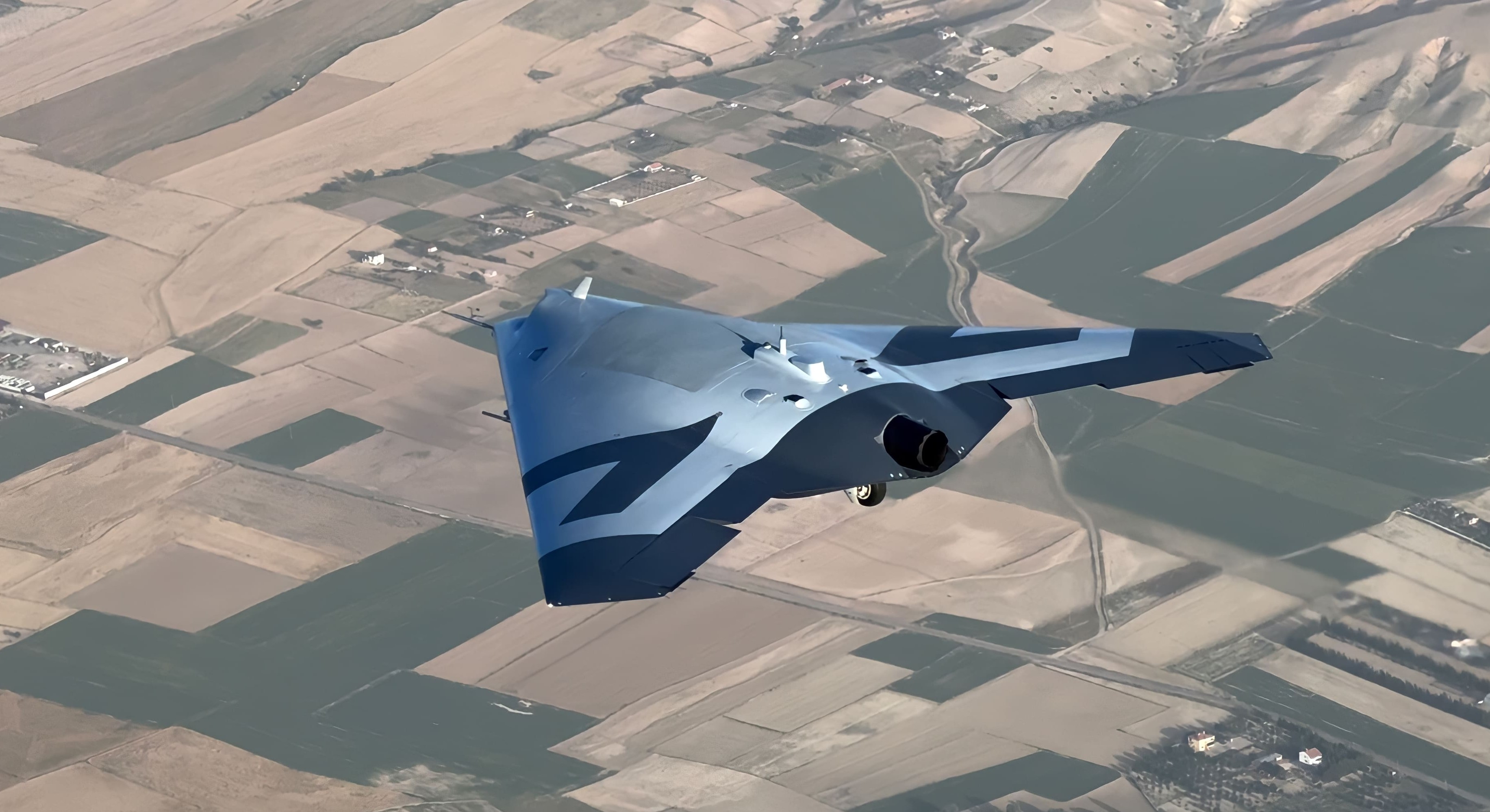
The defense industry is the clearest measure of the distance traveled. In 2004 Türkiye was a customer, buying allied kit. By 2025 its defense and aerospace exports hit a record $8.5 billion, the country's defense-industries chief said, led by the drones that made its reputation from Libya to Ukraine. The technology has moved past propeller-driven scouts, too: Turkish Aerospace's ANKA III, a jet-powered stealth flying wing built to slip past air defenses, first flew in 2023 and is the kind of hardware that used to arrive only from Washington or Western Europe. The TCG Burgazada, a Turkish-built corvette, spent last month docked at a Belgian naval base for Belgium's Navy Days. Francken toured it and said Europe could "learn a lot" from the technology on board.
The geography that mattered in 2004 still matters, and now it is read on a wider map. Türkiye controls the straits into the Black Sea under the Montreux Convention, anchors the alliance's southeastern flank, and has been central to Ukraine's ability to keep fighting. Retired ambassador Hüseyin Diriöz, once a NATO assistant secretary general, argues in an Anadolu Ajansı analysis that the country's real value is that it does several jobs at once: a Black Sea power, a Mediterranean actor, a player in the Caucasus and the Middle East, and one of the few allies that keeps a working line open to Moscow. He counts that open line, the one that produced the Black Sea grain deal, as an asset the alliance is short of, not a loyalty to question. Russia, in his telling, stays a serious strategic challenge; the point is that Ankara can talk to it when no one else can.
Courted in the open
The courting is happening in public. Francken called Türkiye "a very important ally, a long-standing ally," and said flatly, "we need Türkiye within NATO." He wants it inside SAFE-II, the European Union's defense-financing scheme, and called its absence from the first round "a mistake."
Getting there runs into politics that predate the summit. Türkiye's defense cooperation with the EU keeps snagging, and analysts point to Greece and the Greek Cypriot Administration using European mechanisms to slow it down. EU defense funds move by consensus, so a single member can hold them up, and Athens and the Greek Cypriot Administration tie any opening to the disputes they want settled first, in the Aegean and over Cyprus. Ankara's position is that a partner carrying this much of the alliance's southern security should not be locked out of its industrial programs. Whether the summit shifts that is doubtful, and no one on the Turkish side is betting on it.
The stage, and the show
Alongside the leaders' meeting runs the NATO Summit Defense Industry Forum, which Türkiye's Presidency of Defense Industries will headline with a reception at the Turkish Aerospace facilities outside Ankara. Analysts expect it to produce billions of dollars in contracts, a figure worth treating as a forecast until the signatures are on paper.
The guest list reaches past the Atlantic. South Korea's president, Lee Jae Myung, is flying in to give a keynote at Secretary General Mark Rutte's invitation, and Japan's defense minister will be the first from his country to attend a NATO summit, both there to deepen defense-industry ties. The ally drawing the most attention comes from the other side of the Atlantic. Donald Trump is expected in Ankara with a program that starts at Anıtkabir and moves to the Beştepe presidential complex, and an agenda that reportedly includes the F110 engines for Türkiye's KAAN fighter and a possible return to the F-35 program.
In 2004, Türkiye was the place NATO's operations passed through. In 2026, it is where the alliance's production and its diplomacy meet for two days. The role has changed. The weight has not dropped; if anything it has grown. Rutte has said the Ankara summit may matter more than last year's in The Hague. For 48 hours in July, the alliance runs through Ankara, and the argument about NATO's future gets held in a country that has spent 22 years turning itself into part of the answer.