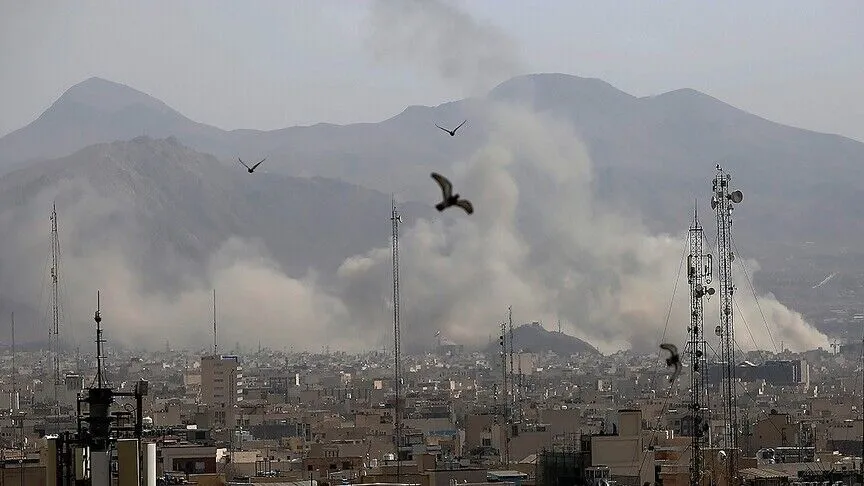
Two American soldiers are dead, and the war between the United States and Iran has reached a place neither side had taken it before. The two were killed on 17 July when Iranian missiles and drones struck a base in Jordan, the US Central Command said, the first American combat deaths reported since the war reignited this month. Washington answered with strikes that have now run for thirteen straight nights, aimed at the Revolutionary Guard units it blames for the attack and at Iran's hold on the Strait of Hormuz. Türkiye sits at the edge of all of it, and its foreign minister spent Sunday in Doha working to keep the Gulf from tipping further.
Key developments
- A new lever: frozen Iranian money. Trump said on Thursday that the damage to ships and cargo in the Strait of Hormuz would be paid for out of "Iranian Money that the United States has in its possession, and controls," calling it "the fair and equitable thing." Iran's foreign minister, Abbas Araghchi, called seizing another country's assets to cover future claims "an incendiary precedent" and warned the "ensuing chaos will not be pretty or peaceful." The June memorandum had committed Washington to release those same frozen funds, so the move turns one of the deal's own terms into a weapon.
- Iran claims a hit on Kuwait. The Revolutionary Guard said on Friday that a drone strike had "completely destroyed" an ammunition depot at the US-used Ali Al Salem Air Base in Kuwait and left "a large number" of US personnel dead or injured. Kuwait and the United States did not confirm the attack or report any casualties, and the claim is Tehran's, untested. Elsewhere, air defenses shot down five drones over Erbil in northern Iraq, and a major Iraqi airport suspended flights after a reported drone crash.
- Four US dead. Two soldiers were killed in an Iranian strike in Jordan on 17 July and a third the next day in northern Iraq while disposing of a downed drone. A fourth, Sgt. Angel Rampersad, 28, listed missing after the Jordan attack, is now believed to have been killed, the Pentagon said on Tuesday.
- A thirteenth night, and a threat of more. US forces have now hit Iran for thirteen consecutive nights, CENTCOM says, targeting the Revolutionary Guard forces it blames for threatening shipping. Trump told Axios he is weighing the "largest strikes yet," a "massive attack" that would be "bigger than ever before," after Iran struck back across the Gulf, hitting a telecommunications tower in Kuwait and sites in Bahrain and Jordan.
- A US strike on Qeshm. Iranian media reported that a US missile hit Qeshm Island, at the mouth of the Strait of Hormuz; no casualties were reported. Iran says the overall death toll from the US strikes has risen to 55.
- The cost. The war has cost the US an estimated $110 billion so far, according to Al Jazeera, and the Pentagon is seeking $67 billion more.
- Oil near its highest since spring. The price reports diverge. Anadolu Ajansı put Brent at about $94.9 on Thursday, its highest since 11 June, easing slightly on Friday; the BBC and Al Jazeera describe crude "back over $100." The gap is partly which benchmark each is citing, but the direction is agreed: the fighting and the threat to Hormuz have pushed prices to their highest in months.
- A ceasefire rejected. Iran turned down a US ceasefire proposal delivered by Iraq's president. An earlier track brokered by Pakistan and Qatar, to restore the positions both sides held before 9 July, has not held.
- Türkiye's push. Foreign Minister Hakan Fidan, coordinating with Qatar, is pressing for de-escalation and a return to the June peace deal.
The first American deaths
The Central Command's account is spare. "On July 17, two U.S. service members in Jordan were killed in action as U.S. Central Command (CENTCOM) and partner forces defended against Iranian ballistic missile and drone attacks," it said on Saturday, according to Anadolu Ajansı. The service member then listed as missing, Sergeant Angel Rampersad, 28, of New York, is now believed to have been killed in the same attack, the Pentagon said on Tuesday, raising the American toll to four. Four others were flown to hospitals in Jordan and have since been discharged. The command said it would withhold the names of the dead until a day after their families were told. Trump called the deaths "a very sad thing," telling one US outlet, "We hate to see it happen. It's in service to our country."
The toll then rose again. On 18 July a US service member was killed and another wounded in northern Iraq, CENTCOM said, during a controlled detonation of ordnance from a downed Iranian attack drone, the third American death of the war.
The answer came fast and was aimed to make a point. CENTCOM said it launched a new wave on Saturday evening "to further degrade Iran's ability to threaten commercial shipping in the Strait of Hormuz and swiftly punish" the Guard forces that hit the base in Jordan, then reported hours later that it had finished an eighth consecutive night against Iranian coastal surveillance, air defenses, maritime forces, and missile and drone storage. The BBC, reporting the same exchange, said the strikes hit coastal and air-defense sites, and that both sides now stand accused of striking each other's critical infrastructure. The nights before had already moved from military targets to the machinery of daily life, one strike knocking out a desalination plant in the south and cutting water to thousands, according to Al Jazeera. By Sunday the campaign had run to a ninth straight night, and for the first time the strikes reached Tabriz, in Iran's northwest near the Turkish border. It pressed on through the days that followed: by Tuesday CENTCOM said it had carried out an eleventh consecutive night, hitting Iranian operations centers, aircraft hangars and drone stores.
Iran's answer, and the strait
Iran's retaliation reaches across the Gulf, though the fuller claims are hard to stand up. Iranian state media said Qeshm Island, in the Strait of Hormuz, had been struck, and Iran's army said it had carried out drone attacks on two US bases in Kuwait. Tehran's earlier claim of hitting American bases in five Gulf states is only partly borne out by what can be seen on the ground, sirens in Bahrain, a fire at a Kuwaiti power and water plant, drones downed over Jordan. Iran's Atomic Energy Organization added that a US strike hit the Darkhovin nuclear plant, still under construction, calling it "a clear violation of international law." It gave no damage detail, and the claim is unverified.
The strait itself is where the war and the world's oil meet. Iran's Revolutionary Guard, in a statement carried by the semi-official Fars agency, said two ships had "an accident" trying to cross Hormuz by an "unsafe route" with US backing, that two more were turned away, and that the channel is under its "complete control," with only the lane Iran designates counting as safe. Washington, for its part, says a naval blockade of Iran's ports stays in force. The fog is thick enough that the two governments could not agree on a single airport: the US Embassy in Amman said Jordan had evacuated the airport and seaport at Aqaba over a "specific and credible threat," and Jordan denied it, its state broadcaster saying both ran without interruption. For all the competing claims, the oil kept moving: US Energy Secretary Chris Wright said about 14 million barrels a day were still leaving the Gulf, roughly seven million through Hormuz and as much again through bypass pipelines, and that traffic in the strait had not stopped. By Monday the strain was showing in prices: Brent crude neared $88 a barrel and US pump prices reached $4 a gallon, a second straight week of increases, with the Houthis' declaration of a blockade on Saudi Arabia adding to the pressure. The US military, meanwhile, said it had redirected seven commercial vessels and disabled another while enforcing its own blockade of Iran.
Where Türkiye stands
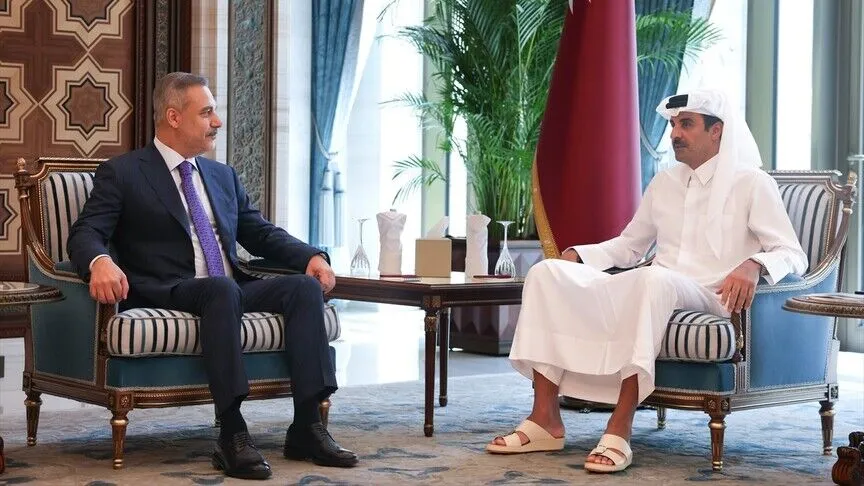
Foreign Minister Hakan Fidan spent Sunday in Doha, where he met Qatar's prime minister and foreign minister, Sheikh Mohammed bin Abdulrahman Al Thani, according to Türkiye's Foreign Ministry. Ankara had set out the purpose a day earlier: Fidan would carry Türkiye's "strong solidarity and support for Qatar" after the recent attacks on it, one of the Gulf states caught in Iran's fire, and would press a familiar line, that "regional issues should be addressed through dialogue and diplomacy, based on the principle of regional ownership." A lasting end to the tensions in the Gulf and heading off another round of escalation, the ministry said, "remain the most urgent priorities." The two governments are also preparing a high strategic committee that Erdoğan and Qatar's emir are to co-chair later this year. The same day, the ministry said, Fidan telephoned Jordan's foreign minister, Ayman Safadi, to discuss the region's security, carrying Ankara's diplomacy to the country where the two American soldiers were killed.
Fidan went further in an interview with Qatar TV, urging a return to the June memorandum and saying Türkiye was coordinating closely with Doha, which was using "all available channels" to resolve the crisis. "Hopefully, we will receive good news in the coming days," he said. That coordination produced something concrete on 20 July, when Pakistan and Qatar put a joint proposal to Washington and Tehran, urging both to return to the positions they held before 9 July as a first step toward resuming talks. Iran's foreign ministry said it had received the mediators' proposals and was reviewing them. Israeli media offered a darker read the same day: Channel 13 reported, without confirmation from either side, that Trump had warned mediators to prepare for escalation if no ceasefire came within the week.
That posture reflects where Türkiye sits. It borders Iran, hosts millions who fled earlier wars in the region, and depends on the Gulf's energy and the sea lanes now under fire. A contested Hormuz raises the price of the oil that reaches Turkish ports and unsettles the trade Ankara has spent years building with the same Gulf capitals Iran is now striking. Through the war Türkiye has condemned the strikes on Iran, and it has not blessed Iran's missiles and drones against its Gulf neighbors either. Ankara's whole effort goes to the space between the two.
In June the United States and Iran signed a Pakistan-brokered memorandum meant to end the war. Six weeks on, it is four American soldiers dead, a thirteenth night of bombing, and the same frozen funds the deal promised to release now marked to pay for the wreckage in the strait.
That thirteenth night was the last of the run. This account closes on 24 July. Our current report on the war is Iran reports its first night without US strikes in two weeks.