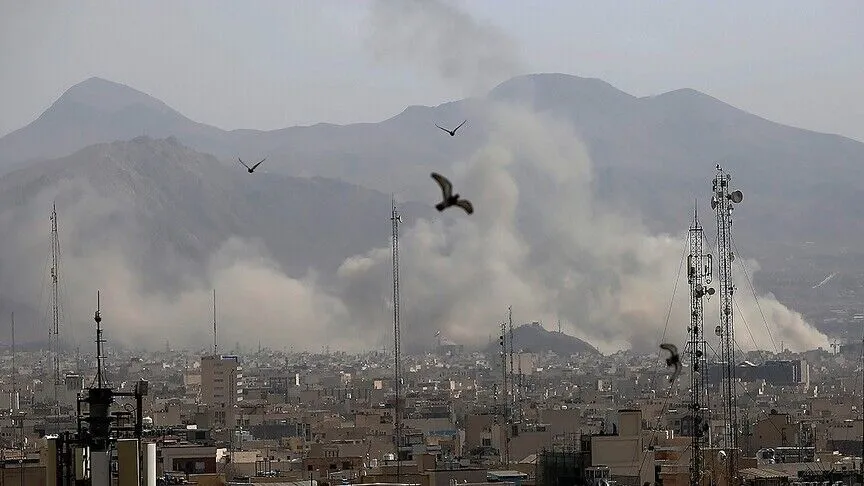
For 13 nights the pattern held. American strikes hit targets inside Iran, and by US news accounts Central Command announced each round as it came.
Then the announcements stopped, and so did the strikes. Three days have now passed with neither side reporting an attack, and on Monday the oil market decided that meant the war was ending.
The latest. Brent crude was trading at around $88.06 on Monday 27 July 2026, giving back a rally that had carried it above $100 last week. Trump said Washington was holding "good talks" with Tehran and that an agreement was possible, warning that the strikes could resume if the negotiations failed. Iran's foreign ministry had said that morning that there are no negotiations with the American side at all, only messages passed by mediators, and that the Strait of Hormuz remains closed. Tehran has opened a separate channel with Oman over navigation through the strait, and says it has suspended its retaliatory operations. Iran's Khatam al-Anbiya Central Headquarters warned that any move to enforce a US naval blockade would count as "an expansion of the war in the region." The blockade, reimposed on 14 July 2026, is still running.
What the market bought
The traders and the ministry were reading the same three quiet days and pricing them very differently.
Brent had briefly touched $102 last week, the highest since May 2026, on fears that the closure of the strait would choke off a fifth of the world's seaborne oil. It gave most of that back inside three sessions. Anadolu Ajansı put Brent at $88.06 a barrel at 1845 GMT on Monday, with the American benchmark at $82.35.
A supply change pushed the same way. Loadings resumed at the Caspian Pipeline Consortium terminal on Russia's Black Sea coast, the main export route for Kazakh crude, putting barrels back into a market that had been pricing their absence.
Traders had reason to hold something back. Yemen's Houthis claimed attacks on Aramco facilities at Jizan and Yanbu over the weekend, and neither the Saudi government nor Aramco has confirmed them.
Susannah Streeter of Wealth Club, quoted by the BBC, said markets were staying "cautious given the twists and turns during this conflict," and that there was "a reticence about whether negotiations will lead to a lasting breakthrough."
The caution has something behind it, because the two governments do not describe the same conversation.
Donald Trump said on Friday night that the Iranians "are talking to us right now; they'd love to make a deal." He did not think they were ready to, he added, but he was willing to listen. By Monday he was firmer, saying Washington was holding good talks with Tehran and that a deal was possible, with the strikes available again if the talks came to nothing.
Esmail Baghaei, the Iranian foreign ministry's spokesman, told his weekly press briefing in Tehran on Monday that mediators may be carrying messages from the American side. "But at present, we have no negotiations with the American side," he said. He dismissed reports that Tehran had asked for talks: "Claims that Iran has requested negotiations are merely reports."
His condition for starting them is not a term anyone could sign. The United States, he said, "must learn how to behave like a responsible government," accusing Washington of behaving "like a mafia gang" for the past year or two by disregarding international law. As long as that continues, he said, "we cannot hope to create a favorable public atmosphere."
He also said the strait is still shut.
Prices are a forecast. The closure is a fact, and it is the one Baghaei restated.
Some of this has already reached American drivers. The average price of a gallon of regular gasoline was $4.11 on Sunday, according to the motor club AAA, against $3.90 a month earlier and $3.15 a year ago. Traders are pricing a 36% chance the Federal Reserve raises its main interest rate at an upcoming meeting, on CME Group data.
Americans have noticed how the war is going. In a CBS News and YouGov survey taken 22 to 24 July 2026, 76% said the conflict has proven more difficult than the Trump administration expected. Just 19% said they felt optimistic about it.
The generals asked for the pause, and the ambassador disputes why
Two accounts published on Sunday put the decision inside the room where it was made, and both describe the military asking Trump to stop rather than the other way around.
Axios reported that the CENTCOM commander, Brad Cooper, told the White House that two weeks of intensive strikes around the Strait of Hormuz had "significantly degraded" Iran's ability to hit commercial vessels, and that the designated targets were "mostly exhausted." Continuing, on that reading, would achieve nothing further short of a full-scale war. Sources told Axios the assessment weighed heavily in Trump's decision on Friday. CENTCOM declined to comment on the briefing.
Alongside it came a supply problem. General Dan Caine, chairman of the Joint Chiefs of Staff, warned Trump and Defense Secretary Pete Hegseth that a dwindling stock of air-defense interceptors could leave American personnel and allied countries exposed if Iran retaliated.
CNN, reporting on the same Friday meeting, said Vice President JD Vance joined Caine in urging the president away from a major escalation. Caine told him about the munitions shortage while saying US forces had options and could succeed, and set out what a return to full-scale combat would cost: mass civilian casualties, regional spillover, and a refugee crisis. Officials also cautioned that Trump's threats to hit civilian infrastructure, roads, bridges and power plants, could leave millions of Iranians without electricity or food, and that Iran could answer by striking Gulf energy and desalination plants, which is where the region's drinking water comes from.
Mike Waltz, the US ambassador to the United Nations, told NBC on Sunday that Trump is giving the talks "some space" and "keeping all options on the table." Negotiations are running at "every level," Waltz said, and the Iranian leadership should take the president very seriously. Asked directly whether Trump had decided against escalating, he said: "I wouldn't go that far at all." He also said the US military remains "locked and loaded."
Speaking to Fox News, Waltz denied the part about the interceptors, dismissing the idea that the American stockpile is running low.
Neither the Axios nor the CNN account has been confirmed by the White House, and both rest on unnamed sources. Waltz's denial rests on his own authority. What is visible from outside is that the bombing stopped.
The argument is still about a shipping lane
Underneath the strikes, the dispute is about who directs traffic through the Strait of Hormuz.
Iran's foreign minister, Abbas Araghchi, accused the United States this month of forcing open a new route through the strait that goes around Iranian authorities. He says that breaks the memorandum of understanding the two sides signed in June 2026, which in Tehran's reading gives Iran the right to set transit routes and mechanisms. Washington should have consulted, he said, since the two had agreed to keep a direct line open for exactly these disputes.
The United States rejects that reading and has said repeatedly that Iran does not control the strait. Washington wants Tehran to stop attacking commercial shipping and to guarantee free passage. Tehran wants transits run through its own mechanism, along its own coastline. The gap between those two positions is the war's current engine.
The one track that is moving runs between Iran and Oman, the two countries facing each other across the water, and Washington is not part of it. Baghaei said the two held talks on Friday and Saturday about managing ship traffic, called them positive, and said the United States has nothing to do with them. The stated aim is for the two coastal states to work out how to keep navigation safe "while respecting the sovereign rights and sovereignty of both coastal states, as well as Iran's security and national interests."
Which is Tehran's position restated as a negotiating objective. The strait was treated as an international waterway before the war.
By Monday evening that channel had hardened into the one Tehran was willing to name. Iran said it had entered talks with Oman over navigation through the strait, and that it had suspended its retaliatory military operations. Those are the negotiations Iran will admit to, and Washington is not in them.
Iran has been enforcing its version at sea. The Revolutionary Guard's navy said it stopped six vessels over 24 hours into Sunday that had tried to cross "without authorization and outside the designated shipping route," firing warning shots before turning them around, after four the previous day. That account is Iranian state television's, and the shipowners have not given theirs.
Iranian media also reported on Sunday that an oil tanker exploded in the strait after striking a naval mine, the Defapress website citing an informed source, in an account carried by the semi-official Mehr agency. It still comes with no vessel name, no casualty figure and no independent confirmation, and it would matter a great deal if it held up.
What did not stop
The blockade has been in force since 14 July 2026. On Saturday the US military said a dozen commercial ships had been redirected, two disabled and two boarded, and that its forces "remain highly vigilant, focused, lethal, and ready."
Iran now says enforcing it would widen the war. The Khatam al-Anbiya Central Headquarters, the command that runs Iran's joint operations, said in a statement carried by the Fars agency that American forces had spent three days threatening Iranian vessels, commercial ships and tankers in Iranian waters, and that pressing a naval blockade "will be regarded as an expansion of the war in the region." Iran's armed forces, it said, would leave no hostile action unanswered.
Commercial traffic through Hormuz was at a three-week low, according to a maritime body overseen by the US Navy, which also said no new attacks had been confirmed in the previous 72 hours.
Two drones were shot down over Jordan on Monday, the army said, with no casualties and no damage, according to a military source quoted by the state-run Petra agency. No group claimed them. The Israeli military separately said it had intercepted two drones near the Jordanian border that did not cross into Israeli territory, and that it was still reviewing where they were launched from.
Baghaei accused unnamed countries in the region of joining the American campaign, saying they had made their territory available "contrary to all principles of international law and good-neighborliness" and that in some cases "we know that they independently participated." Gulf governments have repeatedly denied taking part, and have accused Iran of hitting civilian infrastructure in its strikes on their territory. He also attacked Bulgaria, whose parliament approved US use of an air base for Middle East operations on 22 July 2026, saying its decision-makers would have to answer for making the country complicit.
Tehran's anger has widened past the war itself. Baghaei called the United States, Israel and Ukraine a "triangle of evil" after Kyiv struck an Iranian vessel in the Caspian Sea, an attack Araghchi says killed a sailor.
The messages, and the clock
Mediators led by Qatar and Pakistan have made progress toward restoring the interim ceasefire, two regional officials told AP on Monday, one describing it as significant. They said the mediators were working with Iran and Oman on the transit mechanism.
Both of those things are true at once. Messages are moving between Washington and Tehran and the two are not sitting down together, because the mediators are that channel in its entirety.
They are working against a deadline. The 60-day period set by the June 2026 interim deal is well into its second half, and the question the deal was meant to settle, Iran's nuclear program, has been pushed aside while the two sides argue about shipping lanes.
Benjamin Netanyahu flew to Washington to see Trump on Tuesday 28 July 2026.
Iran's health ministry said on 23 July 2026 that 57 people had been killed and 629 injured in the latest wave of American strikes.
Three days had passed cold. The ships were still being turned around at gunpoint, and the strait was still closed.
Where it stands
The quiet held until the evening of Tuesday 28 July 2026.
US Central Command said the Revolutionary Guard launched multiple ballistic missiles from Iran at American forces in the Middle East at 5:45pm Eastern time (2145 GMT), in what it called an attempted surprise attack, and that all of them were intercepted.
CENTCOM named no targets. Local media in the region, and Al Jazeera, reported that the missiles were aimed at US bases in Jordan. Tehran had made no comment by the early hours of Wednesday.
In the same announcement, CENTCOM said American and Saudi forces had struck what it described as multiple terrorist logistics and weapons sites in eastern Iraq, calling it a response to more than 30 drone attacks directed by the Revolutionary Guard over the previous 72 hours.
Saudi Arabia had said earlier that day that it intercepted drones aimed at petroleum facilities in the east of the country, and its defense ministry blamed Iran-affiliated militias operating from Iraqi territory.
All of it happened while Netanyahu was in Washington.
The strait was the argument before the strikes stopped, and it was still the argument when they resumed.
This article is the record through 27 July 2026 and is no longer being updated. Later developments are covered in the pieces linked below.
Corrected on 28 July 2026: an earlier version, including the headline, said Brent fell about 10% on Monday and that the American benchmark was down 8%, citing Anadolu Ajansı. Those percentages could not be reconciled with the closing prices in the same report and have been removed. The price levels are unchanged.
Corrected on 29 July 2026: an earlier version said Trump and Netanyahu "last met in February 2026, weeks before they launched the war." The date of their previous meeting was not established by our sourcing, and the war began on 28 February 2026, which leaves no room for the interval described. The claim has been removed.