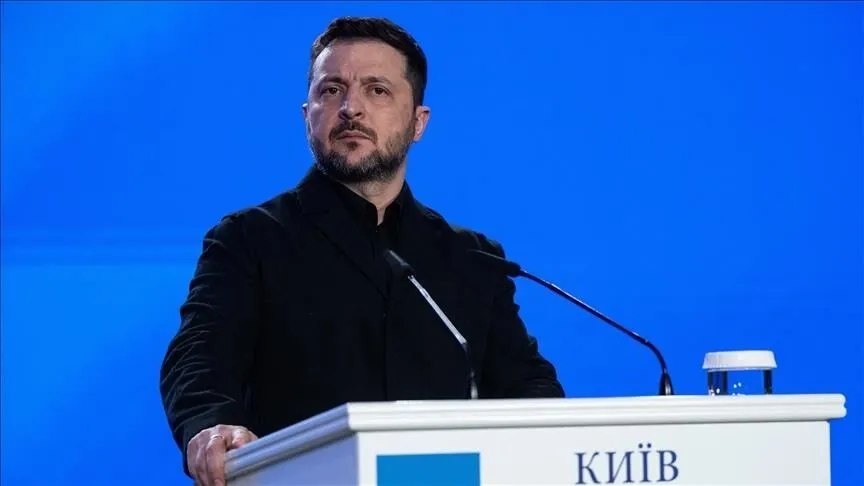
Volodymyr Zelenskyy announced the strikes himself on Saturday. "Very strong results" in the Caspian Sea, he wrote, against "vessels used in military cargo shipments involving Iran, as well as a warship." Ukraine's Security Service confirmed the operation, describing the target as an Iranian ship moving military cargo between Iran and Russia while evading sanctions.
Iran described the same morning differently. An explosion aboard an Iranian commercial vessel, its foreign ministry said, one sailor killed and another injured, in a "hostile and criminal" act of aggression.
Neither government has produced evidence for its version, and Zelenskyy did not name the ship Tehran named. The Kyiv Independent, reporting from Ukraine, said plainly that it could not verify the Iranian account.
Something did explode in the Caspian on Saturday. And two wars that had never met head-on, Russia's against Ukraine and the one between the United States and Iran, have started to touch.
Tehran summoned Ukraine's chargé d'affaires the same day. The summons was delivered by Manouchehr Moradi, the assistant foreign minister who handles Eurasia, who conveyed Iran's "strong protest" and warned that attacks on the lives and property of Iranian citizens "will not go unanswered."
The foreign ministry reached for the UN Charter, calling the attack a violation of Article 2(4), the provision barring the threat or use of force against another state. It invoked the right of self-defense under international law, said the incident could "further inflame and expand" the war between Russia and Ukraine, and called on the Security Council, European governments and every UN member state to hold Kyiv's leadership to account.
It also made a point of saying Iran has never intervened in that war.
That claim is precisely what Ukraine's strike disputes. Kyiv's position, implicit in the SBU's description of the cargo, is that a ship running sanctioned military freight between Tehran and Moscow is a legitimate target in a war Iran says it is not part of. Iran's position is that a commercial vessel and its crew are not. Both are legal arguments, and no court has ruled on either.
Abbas Araghchi, Iran's foreign minister, took the complaint to Brussels. In a call on Saturday with the European Union's foreign policy chief, Kaja Kallas, he condemned the attack and demanded a "firm response" from the Security Council, the EU and the international community, along with accountability for those responsible and for those supporting them. Al Jazeera read that second clause as a reference to Europe's military assistance to Ukraine. The call also covered the Strait of Hormuz. The account of it comes from Iran's foreign ministry; the EU has not published its own.
By Sunday his language had hardened, and the list of people he had called had grown. Araghchi wrote that Zelenskyy "killed a sailor by attacking an Iranian commercial ship," called it a clear violation of the UN Charter, and said he had told both Kallas and Russia's foreign minister, Sergey Lavrov, that the act by what he called the "parasitic" administration in Kyiv "will not go unanswered."
In the same message he put Israel at the center of it, saying the attack had been carried out at Israel's instigation in order to drag Europe into its war. He offered no evidence. Nothing in Ukraine's account of the operation, or in the reporting of it so far, involves Israel.
The geography makes this more than one more exchange of statements. Iran is now taking pressure on three bodies of water at once. The US Navy has blockaded its ports in the south, and the argument over who directs traffic through the Strait of Hormuz is unresolved. The Houthis have made the Red Sea unreliable. The Caspian, landlocked and ringed by five states, was the route nobody was shooting at.
Al Jazeera's correspondent in Tehran, Tohid Asadi, reported that the northern strikes are putting "extra pressure" on Iranian maritime trade at a moment when the southern coast is already sealed.
Zelenskyy made a second claim on Saturday. Russia, he said, has been passing satellite imagery of Gulf states and American military sites to Tehran, with surveillance on 19 and 20 July covering airbases in Bahrain, Jordan and Kuwait. That allegation is his, and it is unverified.
It is also his argument for a position Ukraine took months ago.
Ukraine was already in this war
On 5 March, Washington asked Kyiv for help defending American bases against Iranian drones. Ukraine agreed the same day and sent the team the next, Zelenskyy said in an interview published on 9 March. The destination was a US military base in Jordan.
The deployment grew from there. By 20 March, Zelenskyy said 228 Ukrainian specialists were working in five countries that had come under Iranian fire: the United Arab Emirates, Saudi Arabia, Qatar, Kuwait and Jordan.
The division of labor explains why anyone wanted them. Local air-defense units handle the ballistic missiles. The Ukrainians were put on the Shahed waves, because that is the war they have been fighting at home since 2022, against drones built to an Iranian design. Four years of it has made Ukraine one of the most experienced countries in the world at shooting them down.
Kyiv is not doing it for nothing. Zelenskyy said 11 countries had asked for the technology, the electronic warfare systems or the training, and that Ukraine wanted money and technology back in exchange. A country short of both is selling the one thing its war has produced in surplus.
All of those figures are from March, and TurkishPress could not confirm how many Ukrainian personnel remain in the region now.
The warning came back from inside the Iranian parliament. Ebrahim Azizi, who chairs its national security and foreign policy committee, wrote that Ukraine could become a "legitimate target." His words: "By providing support to the Israeli regime with drones, the collapsing Ukraine has in fact become involved in the war." He offered no evidence for the accusation, and he chairs a committee rather than speaking for the state.
Four months after the deployment, an Iranian ship blew up in the Caspian.
Ukraine has been attacking ships for a long time, hunting Russian tankers in the Black Sea with naval drones. The Caspian is new, and what happens there next is the open question: whether Saturday was the opening of a front, or a way of squeezing Iran's economy without opening one.
For Iran, the distinction may not matter much. It has American ships to the south, Houthis in the Red Sea, and now something in the water to the north. The Caspian was the safe one.