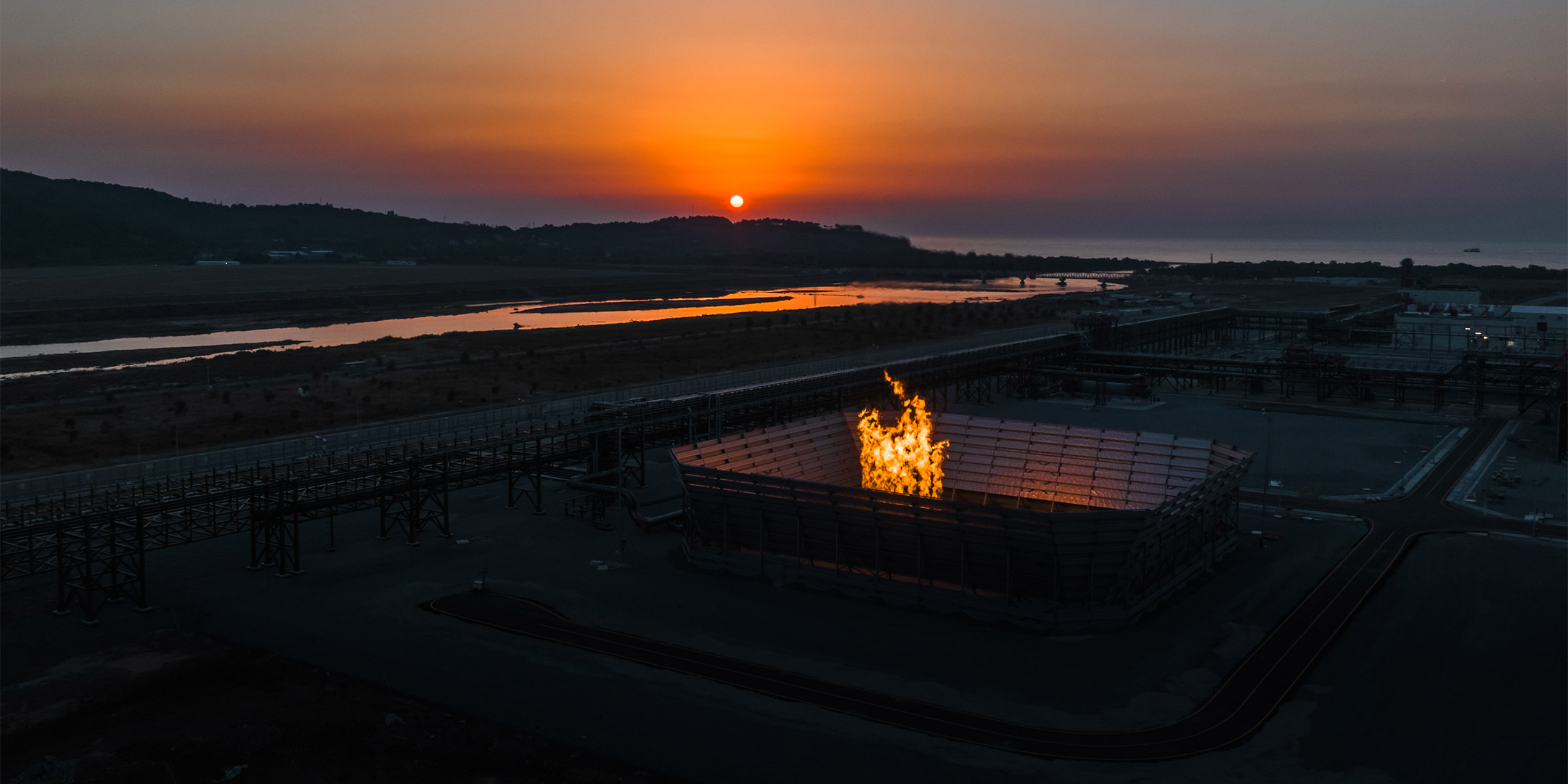
On 15 January 2026, Energy and Natural Resources Minister Alparslan Bayraktar told reporters in Ankara that the Sakarya Gas Field, Türkiye's first commercially producing deep-water hydrocarbon project, would double its output by the end of the year. "Karadeniz'deki Sakarya Gaz Sahası'ndaki üretimimiz 2 katına çıkacak," he said: "Our production at the Sakarya Gas Field in the Black Sea will double." He added that the project's coming Floating Production Unit, named Osman Gazi, would by then be supplying enough natural gas to cover the household consumption of roughly eight million Turkish homes, up from about four million today.
The statement, reported by Anadolu Agency and TRT Haber, marked the project's transition from a single-phase developmental field into something larger and more strategically consequential: a working Black Sea gas province, with a second field (Göktepe) already booked for connection to the same shore terminal. For a country that imported roughly 99 percent of its natural gas as recently as 2019, the trajectory is significant on its own terms, and significant as a test case for how quickly a state-led deep-water program can move from first strike to production at scale.
From accident to province: the discovery arc
The project's origins lie in a single well drilled in the summer of 2020. On 21 August of that year, the drillship Fatih, operating about 175 kilometers (109 mi) off Filyos on the western Black Sea coast, penetrated a structure later named Tuna-1 and confirmed a major gas accumulation. Initial reserve estimates were 320 billion cubic meters. With the full well log, the figure was revised upward to 405 bcm. The discovery, announced by President Recep Tayyip Erdoğan from the Dolmabahçe Palace, was the largest single offshore gas find in Turkish history.
It was not the last. In June 2021, follow-up drilling at the adjacent Amasra-1 prospect added a further 135 bcm. In December 2022 the appraisal well Çaycuma-1, together with three-dimensional seismic modeling commissioned from the independent reserves auditor DeGolyer and MacNaughton, brought the certified total to 710 bcm. Then, in May 2025, a fourth discovery: Göktepe-3, drilled some 80 kilometers (50 mi) southeast of the Sakarya production area, added an additional 75 bcm and pushed the cumulative Black Sea reserve figure on TP-OTC's books to 785 billion cubic meters. The project's operator no longer describes the asset as a field. The corporate language is "Black Sea natural gas reserves."
The fleet: six ships, four drillships and two seismic vessels
None of the discoveries would have been possible without the offshore fleet Türkiye has assembled over the past decade and a half. The fleet has two distinct functions. The seismic vessels come first: they map the subsurface structures and identify the prospects worth drilling. The drillships come second: they sink the wells that confirm the gas and, once a field is defined, complete the producing wells that feed it to shore.
The two seismic vessels are the Barbaros Hayrettin Paşa, purchased on 31 December 2012 and named after the great 16th-century Ottoman admiral, and the MTA Oruç Reis, a domestic build whose construction began in 2012 and which entered operational testing in August 2017. Both have been used extensively to survey the western Black Sea trough, the structural setting in which the Tuna, Amasra, Çaycuma, and Göktepe accumulations were eventually proven.
The four drillships followed. The Fatih, acquired by TPAO in 2017 from a 2011 South Korean build, was the first. It made the Tuna-1 strike. The Yavuz was purchased in 2018. The Kanuni joined in early 2020, a converted production-and-completion vessel designed for the well-finishing stage that Sakarya now requires at scale. The Abdülhamid Han, the newest and the largest of the four, was purchased in November 2021 for US $180 million and joined the fleet in 2022. The drillships are sixth- and seventh-generation deep-water vessels capable of operating in more than 3,000 meters (9,843 ft) of water, comfortably more than Sakarya's roughly 2,150-meter (7,054 ft) setting requires.
Turkish energy press has consistently identified these six ships as the country's offshore fleet. Specific well-by-well rotations are not published on the operator's project page, and individual ship assignments shift between the Sakarya area, the Eastern Mediterranean, and pre-discovery exploration further afield. What can be said is that all four drillships have been used at Sakarya at different points in the project's life, with the Kanuni in particular dedicated to the well-completion work that has made Phase 1 production possible, and the two seismic vessels have been continuous contributors to the discovery pipeline that keeps the drillships in work.
| Vessel | In Türkiye since | Class |
|---|---|---|
| Barbaros Hayrettin Paşa | 2012 | Seismic survey vessel |
| MTA Oruç Reis | 2017 | Seismic survey vessel |
| Fatih | 2017 | Deep-water drillship |
| Yavuz | 2018 | Deep-water drillship |
| Kanuni | 2020 | Well-completion / drillship |
| Abdülhamid Han | 2022 | 7th-generation drillship |
Three years from first strike to first gas
The interval between discovery and first commercial flow is the part of the Sakarya story most likely to be cited abroad. Deep-water gas projects at this water depth typically take seven to ten years to move from discovery to first production, on the experience of the Eastern Mediterranean (Zohr, Tamar, Leviathan) and the Brazilian pre-salt. Sakarya delivered first gas to shore in April 2023, less than three years after the Tuna-1 announcement. The compressed schedule was made possible by parallel execution rather than serial: subsea infrastructure installation, well completion, and onshore terminal construction at Filyos ran concurrently rather than sequentially.
The subsea segment was carried out largely by foreign contractors operating under TP-OTC supervision. The Italian engineering firm Saipem laid the original 170-kilometer (106 mi) pipeline using its specialized pipe-laying vessel Castorone, one of the largest in the world. Once first gas was achieved, 12 producing wells were in service by mid-2023, yielding roughly 9.2 million cubic meters per day, the Phase 1 plateau.
Independent industry assessment
International upstream research has tracked Sakarya closely since the Tuna-1 announcement. Wood Mackenzie analyst Thomas Purdie called the 2020 discovery "Turkey's biggest-ever find, by a wide margin, and one of the largest global discoveries of 2020," but cautioned that the announced 2023 first-gas target "looks ambitious." When first gas was nonetheless delivered on schedule less than three years later, WoodMac's Ashley Sherman characterized it as "a major project delivery success for TPAO," comparable in delivery speed to Eni's Zohr discovery offshore Egypt. WoodMac's own projection, made at the Phase 1 launch, is that full Phase 2 will cover close to 30 percent of Türkiye's gas demand by 2030. That figure sits somewhat above the 15 to 20 percent range cited in TP-OTC's own communications for end-2026, and reflects both the longer time horizon and the natural decay of contracted import volumes. A 2020 Atlantic Council EnergySource analysis was more cautious, noting Türkiye's then-limited deep-water track record and citing 2019 import figures of more than 45 bcm at a cost of roughly $41 billion. Several of those caveats were overtaken by the speed of Phase 1 delivery.
The Osman Gazi step: a first for Türkiye
Phase 2 turns on a single piece of equipment: the Osman Gazi Floating Production Unit, the first FPU in Turkish service and the seventh ship in the energy fleet. President Recep Tayyip Erdoğan announced the acquisition on 22 July 2024, describing the vessel as a new natural-gas ship destined for Sakarya. Energy and Natural Resources Minister Alparslan Bayraktar characterized it as a platform replacement, "FPSO dediğimiz, platform yerine denizin ortasında lokasyon," a location in the middle of the sea, in place of a fixed platform. The unit is 300 meters (984 ft) long and 58 meters (190 ft) wide, designed for a 15- to 20-year operational life in the Black Sea. It was purchased from a Singaporean owner rather than built from scratch, a sequence-skipping decision that shaved perhaps two years off the schedule, and the platform was towed to Filyos for modification. Its purpose is to do offshore what the onshore Filyos terminal currently does: separate gas from condensate and water, dehydrate it, and feed it cleaned into the export pipeline.
The critical pre-deployment milestone was reached in March 2026, when the platform's 2,500-ton MEG (monoethylene glycol) module, the unit that prevents hydrate plugs in the production flow, was successfully integrated dockside at Filyos. Project communications indicate the Osman Gazi will sail for its operating location in the third quarter of 2026 and begin offshore processing thereafter. It is this platform that underwrites Minister Bayraktar's doubling claim.
Where production stands now, and where it goes
The current numbers and the targets line up cleanly across three time horizons:
- Phase 1 (now): approximately 9.2 million cubic meters per day from 12 wells, equivalent to the household gas consumption of roughly four million Turkish homes.
- Phase 2 (end of 2026): approximately 20 million cubic meters per day, with Osman Gazi in service and the additional Phase 2 wells tied in. Roughly eight million-household equivalent.
- Phase 3 (target 2028): approximately 40 million cubic meters per day from a combined 49 wells, supported by a twin FPU alongside Osman Gazi. Roughly 17 million-household equivalent.
At Phase 2 capacity, the Sakarya field alone would meet between 15 and 20 percent of Türkiye's total natural-gas demand, depending on the season and the size of the domestic gas market in any given year. At Phase 3 capacity, the share would rise meaningfully further.
The Göktepe pivot: what the Saipem contract tells us
The most consequential recent development is not at Sakarya itself but next door. On 2 January 2026, TP-OTC signed a US $425 million engineering, procurement, construction and installation contract with Saipem covering three new pipelines totaling 153 kilometers (95 mi). The work, scheduled for offshore execution in the second half of 2027 again using the Castorone, will tie the newly discovered Göktepe field, at 2,200 meters (7,218 ft) of water depth, slightly deeper than Sakarya's main producing area, into the Phase 3 Sakarya infrastructure. Once connected, Göktepe will flow through the same Filyos terminal that handles Sakarya gas today.
The structural implication is that "Sakarya" is no longer the right name for what is being built. The combined Sakarya-Göktepe footprint, with the Filyos terminal as its onshore choke point, is now a small gas province with at least two producing structures and a 24-month pipeline expansion already under contract. The contracting cadence (discovery in May 2025, follow-up reserve revision and EPCI award by January 2026, installation booked for 2027) is consistent with the compressed schedule the project established at Tuna-1.
The strategic frame
None of this is incidental to Türkiye's gas-import position. The country was, until very recently, dependent on imports for almost the whole of its gas consumption, with the largest flows coming from the Russian Federation (via the Blue Stream and TurkStream lines), Azerbaijan (Trans-Anatolian Pipeline), and Iran. Phase 2 of Sakarya cuts that dependency materially, by perhaps a fifth, with the savings on the import bill, at recent benchmark prices, running into several billion US dollars per year of avoided foreign-exchange outflow. Phase 3 deepens the cut further. The Göktepe addition extends the project's productive horizon into the early 2030s.
It is also a notable case of state-led industrial execution. The operator, TP-OTC AŞ, is a subsidiary of Türkiye Petrolleri Anonim Ortaklığı (TPAO), the state oil and gas company. The Filyos terminal sits on the western Black Sea coast in Zonguldak province and is being expanded in parallel into a broader energy-and-petrochemicals industrial zone. The six-ship offshore fleet, the FPU acquisition strategy, the Filyos terminal build-out, and the EPCI contracting with European specialists are all components of the same program, run on a single timeline.
What remains uncertain is the next discovery. The Black Sea basin's working petroleum system has now been demonstrated at Tuna, Amasra, Çaycuma, and Göktepe; further wildcat programs are continuing further offshore and at greater depths. The fleet that delivered the first province is being held in readiness for the second.
Sources
Turkish state-aligned reporting and operator data
- Anadolu Ajansı, "Bakan Bayraktar: 2026'da Karadeniz'deki Sakarya Gaz Sahası'ndaki üretimimiz 2 katına çıkacak" (15 January 2026). Minister Alparslan Bayraktar's 2026 doubling statement and the 8-million-household figure.
- Anadolu Ajansı, "TP-OTC AŞ ile Saipem, Sakarya Gaz Sahası Projesi kapsamında 425 milyon dolarlık sözleşme imzaladı" (2 January 2026). The Göktepe-connection EPCI contract, scope (three pipelines, 153 km), and 2027 offshore execution timetable.
- Anadolu Ajansı, "Türkiye'nin enerji filosuna 7'nci gemi katılıyor" (22 July 2024). President Erdoğan's announcement of the FPSO/FPU acquisition (the Osman Gazi). Full fleet roster (4 drillships plus 2 seismic vessels) and per-ship acquisition dates.
- TP-OTC AŞ, Sakarya Gas Field project page. Current 785 bcm reserve figure (post-Göktepe), discovery-well chronology (Tuna-1, Amasra-1, Çaycuma-1, Göktepe-3), Phase-by-Phase production targets, 2,150 m water depth, ~170 km pipeline length.
- TP-OTC AŞ, Faz-2 Teknik Olmayan Özet Raporu (Phase-2 Non-Technical Summary), PDF. Official Phase-2 technical and environmental description.
- TPAO, 2023 Petrol ve Doğal Gaz Sektör Raporu, PDF. Sector context and the parent company's reserves accounting.
- TRT Haber, "Sakarya Gaz Sahası'nda üretim 2 katına çıkacak" (16 January 2026). Confirmatory coverage of the doubling statement and the Osmangazi FPU's role.
Independent industry research and international press
- Wood Mackenzie, "Turkey nets largest-ever find with Tuna-1 gas discovery in the Black Sea" (21 August 2020). Analyst commentary at the discovery moment. Thomas Purdie called it Türkiye's biggest-ever find by a wide margin. Murray Douglas covered supplier-negotiation implications with Gazprom, Azerbaijan, and Iran.
- Atlantic Council EnergySource, Ariel Cohen and Talya Yuzucu, "Turkey's gas find in the Black Sea: How big is this Tuna?" (14 September 2020). Independent Western think-tank analytical perspective at the discovery moment. 2019 import figures (45 bcm at roughly $41 billion), comparison to Romania's Neptun Deep (84 bcm), and 2020 caveats since substantially overtaken by Phase 1 delivery.
- Wood Mackenzie, "Sakarya Phase One kick-starts Turkey's upstream sector transformation" (20 April 2023). Ashley Sherman analyst commentary at the first-gas milestone. Phase 2 projection of close to 30 percent of Türkiye's gas consumption by 2030. Comparison to Eni's Zohr in Egypt.
- Offshore Engineer Digital, "Saipem Lands $425M Turkish Gas Contract in Sakarya Expansion" (31 December 2025). Independent Western specialist trade-press confirmation of the Göktepe-connection contract. Cross-checks the 153 km, 2,200 m, 80 km, and H2 2027 specifications.