The graves at Potočari took ten more on Saturday, and there are still more than a thousand people to find.
Thirty-one years after the Srebrenica genocide, the burying is not finished. At the Srebrenica-Potočari Memorial Center, thousands gathered on 11 July for the collective funeral held every year on the date the town fell, and the remains of ten newly identified victims were lowered into the ground. The youngest was Senad Jusić, 20 years old. The oldest was Ramo Dautović, 56. Their bones were pulled from mass graves between 1997 and 2022, some from secondary pits where the killers had moved the bodies to hide them.
With this year's ten, the number of victims resting at Potočari reached 6,782. Around 250 more were buried in local cemeteries where their families wanted them. More than a thousand are still missing, three decades on.
Here is what the graves are counting. In July 1995, Bosnian Serb forces under Ratko Mladić took Srebrenica, a town the United Nations had declared a safe area. The Bosniak civilians who fled to the UN base, guarded by a Dutch peacekeeping battalion that did not stop what came next, were handed over to those forces. Over several days, 8,372 Bosniak men and boys were separated from their families, driven to forests and warehouses and factories, and killed. International courts have ruled it genocide, the worst mass killing on European soil since the Second World War, and Mladić and the Bosnian Serb political leader Radovan Karadžić were both convicted of it.
Türkiye has never used a softer word for it, and it was present again this year. Family and Social Services Minister Mahinur Özdemir Göktaş read a message from President Erdoğan at the ceremony. "On the 31st anniversary of the Srebrenica genocide, one of the most brutal genocides in history, I remember with sorrow and mercy all our Bosniak brothers and sisters who were massacred," it read. "We will never forget Srebrenica."
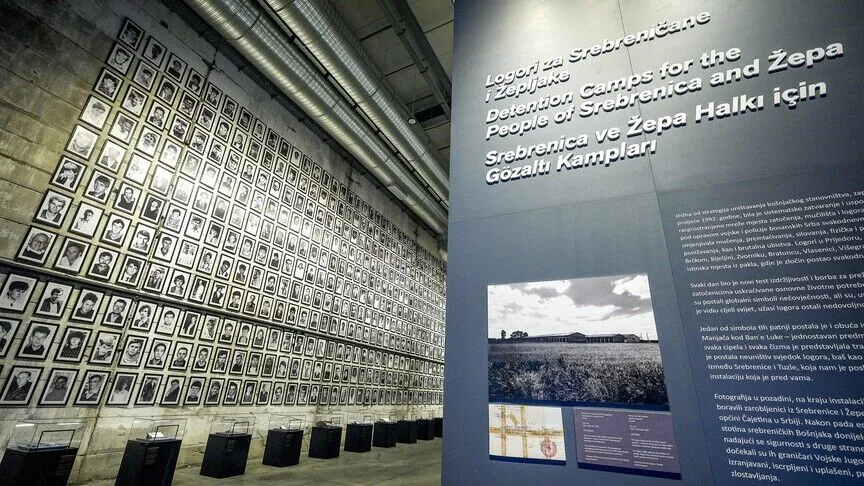
The remembering is the part that still needs work, and it is where Türkiye has put something concrete. A year ago, the Turkish Cooperation and Coordination Agency, TİKA, and the Srebrenica Memorial Center opened a museum inside the former battery factory at Potočari, the same building that served as the Dutch UN base, where the men who would be killed had gone looking for protection. The museum has now stood for a year. Its point is plain: to make the place that failed the victims tell their story instead.
That work matters because the denial has not stopped. At Saturday's commemoration, the chair of Bosnia's presidency council, Denis Bećirović, said the genocide had been planned in detail and carried out "before the whole world's eyes," and that the international community had failed to act when it counted. The head of the organizing committee, Hamdija Fejzić, pointed to the courts' genocide rulings and to the thousands of families still waiting for a set of bones to bury. A British journalist who spent four years in wartime Bosnia, Tony Birtley, stood among the mourners and said he had never been able to forget what he saw.
The messages of solidarity came from beyond the Balkans too. Pakistan's Prime Minister Shehbaz Sharif sent word that his country stands with Bosnia and Herzegovina, as it has before.
Srebrenica has become, in Bećirović's words, a symbol in the search for justice and humanity, and a warning against silence. The warning is the reason the anniversary is not only a funeral. Every year the identified are named and buried, the record is read out again, and the count at Potočari climbs by another handful. This year it climbed by ten, to 6,782. Next year, if the diggers and the DNA labs keep at it, it will climb again, and the museum in the old factory will have stood two years, still doing the one thing that outlasts the men who ordered the killing: it remembers.