The United States may soon let Saudi Arabia enrich its own uranium. Türkiye, right next door and further along in nuclear power, can't make a single fuel rod without Russia.
That gap is the story for Ankara in the deal the two governments signed this week.
The US and Saudi Arabia signed the agreement on Wednesday, the US Energy Department said. Energy Secretary Chris Wright and Saudi energy minister Prince Abdulaziz bin Salman put their names to a "123 agreement," the license the US Atomic Energy Act requires before American nuclear technology can go abroad, along with a bilateral safeguards deal. It is a 30-year pact worth tens of billions of dollars that gives American firms the lead role in building the kingdom's nuclear industry, and it now goes to Congress for review.
The department says the agreement upholds "the highest standards of nuclear safety and nonproliferation." What it does not include is the "Gold Standard," the promise that a partner won't enrich uranium or reprocess spent fuel, the two roads that also lead to a bomb. It skips the tighter IAEA inspections of the Additional Protocol too. And one clause would let American companies build an enrichment plant inside Saudi Arabia if a joint review with Washington decides it's warranted.
The day after the signing, Trump added a condition and a caveat. On Truth Social he said the agreement is "totally subject to Saudi Arabia joining the very respected and successful Abraham Accords," the normalization track with Israel that Bahrain, Morocco, Sudan, and the United Arab Emirates joined in his first term. So the reactors now come with a price for Riyadh: recognize Israel. In the same post Trump insisted there would be "no enrichment of material," calling the plants "Civil (Non-Enriched)," and Rubio said any deal would carry safeguards against a weapons program. Those assurances sit against the text itself, which as signed carries no Gold Standard ban. For now the signed terms and the president's promise point in different directions.
Congress now has about 90 sitting days to look at it. To kill it, lawmakers would need a joint resolution and, against a presidential veto, a two-thirds majority in both chambers. Members of both parties have spent years demanding enrichment guardrails, Marco Rubio among them when he sat in the Senate. Rubio is now Trump's secretary of state.
The contrast with Iran is hard to miss. As Washington settled the Saudi terms, American warplanes were deep into a second week of hitting Iran's nuclear sites, including the enrichment plants at Fordow and Natanz and the conversion complex at Isfahan. Trump has said the aim of that campaign is to end Iran's ability to enrich uranium at all. Iran's foreign minister, Abbas Araghchi, calls enrichment on Iranian soil a red line and a right the Non-Proliferation Treaty guarantees.
One government is being bombed to give up enrichment. Another is being offered a deal that may let it start. The Congressional Research Service points out that a 123 agreement doesn't actually oblige a partner to forgo enrichment or reprocessing. The 2009 deal with the United Arab Emirates did it anyway, the "Gold Standard" that let Washington walk if Abu Dhabi ever enriched, and for years that was the benchmark the US held out for the Gulf. Saudi Arabia refused it. Its energy minister said in 2019 the kingdom wanted "the full cycle, from producing uranium, to enriching the uranium." Crown Prince Mohammed bin Salman has said that if Iran builds a bomb, the kingdom will too.
Read from Ankara, the detail that stings is enrichment.
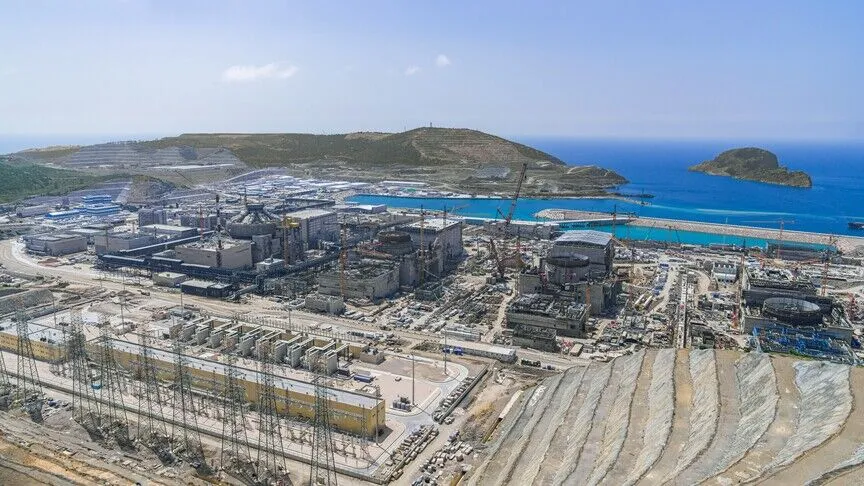
Türkiye has no enrichment plant. It has no conversion plant either, the step before enrichment. Its whole nuclear effort runs on imported fuel, and for its first reactor that means Russia. Rosatom, the Russian state company, is building the Akkuyu plant on the Mediterranean coast in Mersin, and it supplies the uranium that will power it. Energy minister Alparslan Bayraktar told parliament's budget committee in November 2025 that Türkiye relies entirely on Rosatom for that fuel. Akkuyu is due to send its first electricity to the grid this year.
So the picture is a Gulf rival on course for a capability Washington spent years pressing its Gulf partners to give up, while Türkiye, an older US ally and a NATO member, still buys every gram of its fuel from Moscow.
Erdoğan has said before that he finds this kind of hierarchy unfair. At an economic forum in Sivas in September 2019, he told the room that some countries keep missiles with nuclear warheads while he is told he cannot. "I don't accept this," he said. He was talking about weapons, and Türkiye has signed the Non-Proliferation Treaty, so the comparison only goes so far. But the grievance underneath it, that the rules bend for some governments and not others, is exactly what a Saudi deal without that ban revives.
Ankara has been trying to loosen its dependence for a while. For a second plant at Sinop on the Black Sea, Türkiye signed a framework with South Korea's KEPCO late last year and has named both South Korea and the United States as possible partners. Bayraktar keeps returning to the same conditions: cheaper power, Turkish firms doing real work on the build, and a homegrown small-reactor program. None of that is enrichment. It is a country trying to become a builder rather than a permanent customer.
Whether that enrichment plant ever gets built is years off, resting on the joint review and on a Congress that could still say no. Saudi Arabia says its program is only for electricity and desalination. But arms-control specialists have warned for years that one Gulf state reaching for the fuel cycle makes its neighbors want the option too, and the Arms Control Association put Türkiye on that list back in 2019.
For now the question in Ankara is simpler and more personal. If the United States is ready to write these terms for Saudi Arabia, what is it willing to offer the ally that has been buying Russian fuel because no one gave it another option? Türkiye wants a US role at Sinop. It will be reading the Saudi text closely, right down to the line about who gets to enrich.