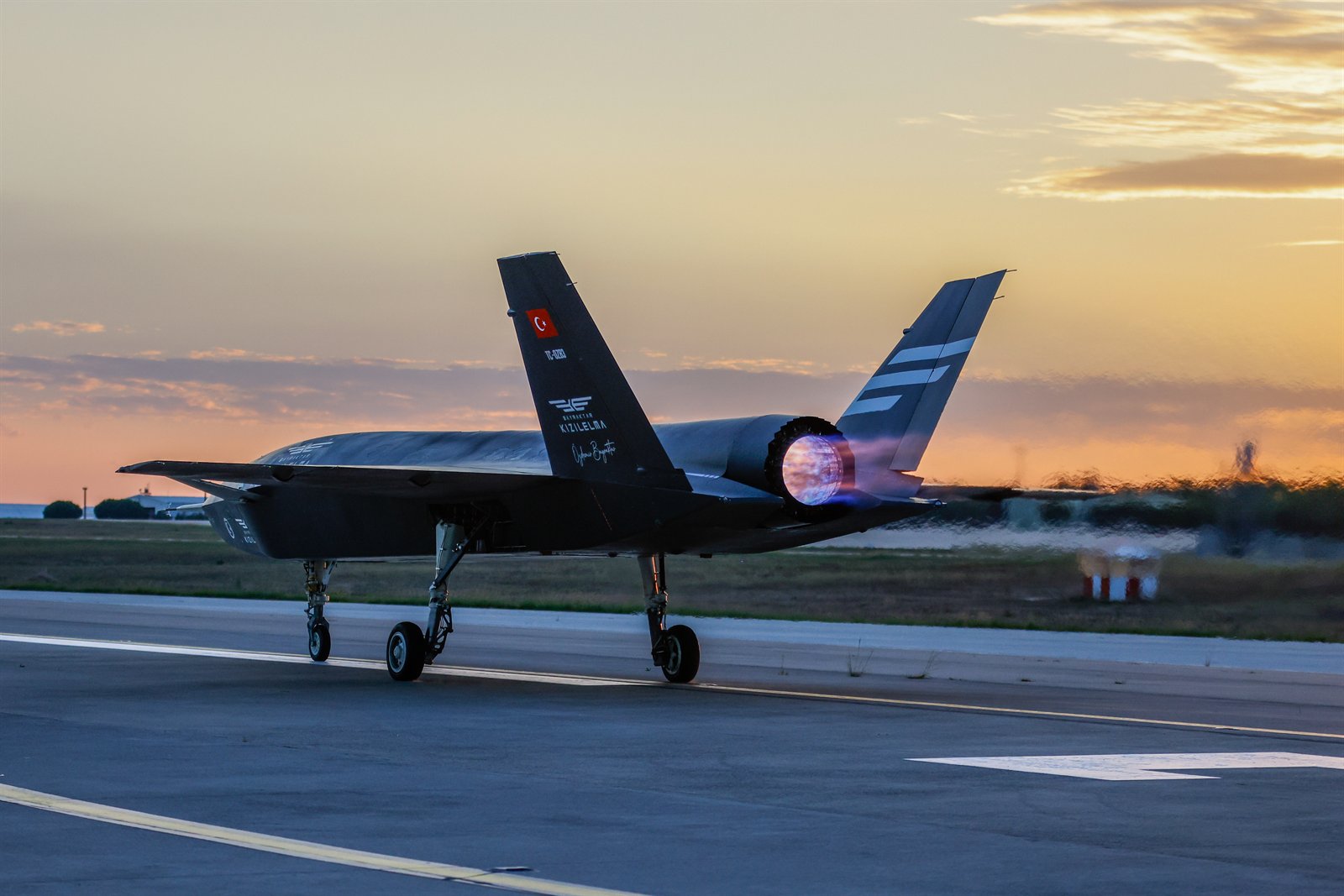
Türkiye's first unmanned fighter jet has fired a supersonic missile for the first time, and it hit what it aimed at. Baykar said its Bayraktar Kızılelma launched a Roketsan JET-230 at a target over the sea on 11 July, striking it from a range of more than 120 kilometers (75 miles). It is the aircraft's first live firing of a supersonic air-to-surface weapon, and one more capability checked off on a jet the company is still building out.
The run was deliberate and documented. The serial-production model, tail number S2, flew on 8 July from the Akıncı Flight Training and Test Center at Çorlu, in Tekirdağ, to the 5th Main Jet Base at Merzifon. Three days later it took off from Merzifon carrying two JET-230 missiles under its wings, turned toward the sea target, and fired. Selçuk Bayraktar, Baykar's chairman and chief technology officer, who led the test, kept his reaction short. "Another milestone completed," he said. "I congratulate you wholeheartedly."
The claim is Baykar's, though the milestone was quickly picked up and confirmed across Turkish and international defense press, including Hürriyet Daily News, which named the JET-230 as a Roketsan air-to-surface supersonic missile. What the test adds is reach and speed: a domestic drone that can now throw a fast, long-range missile at a surface target puts a different kind of threat over contested water than a slower guided bomb does.
The Kızılelma is Türkiye's attempt at a jet-powered unmanned combat aircraft, a step up from the propeller-driven drones that made Baykar's name. Its arsenal is being filled in one weapon at a time, and it is filled with Turkish hardware: before the JET-230 the aircraft had already flown firing tests with the Gökdoğan air-to-air missile and the Tolun, Teber-82 and LGK-82 munitions. The point of the exercise is a fighter that answers to no foreign export license for what it carries.
Two earlier tests set the frame for this one. Off Sinop on 29 November 2025, a Kızılelma destroyed a jet-powered aerial target with a beyond-visual-range Gökdoğan missile, cued by an Aselsan Murad radar and built by Tübitak Sage, which Baykar called the first time an unmanned combat aircraft had shot down a jet-powered air target with a beyond-visual-range missile. A month later, on 27 December, two Kızılelma prototypes flew an autonomous close formation together, one trailing the other as a wingman without a pilot in either.
Baykar can afford to test in public because the market has already voted. The company says it stayed the world's largest exporter of unmanned aircraft in 2025, with a record $2.2 billion in exports and roughly 90 percent of its revenue earned abroad, and it has signed export deals for the Bayraktar TB2 and Akıncı across 39 countries. The Kızılelma is the next thing it intends to sell, and each firing test is also a line in the sales pitch.