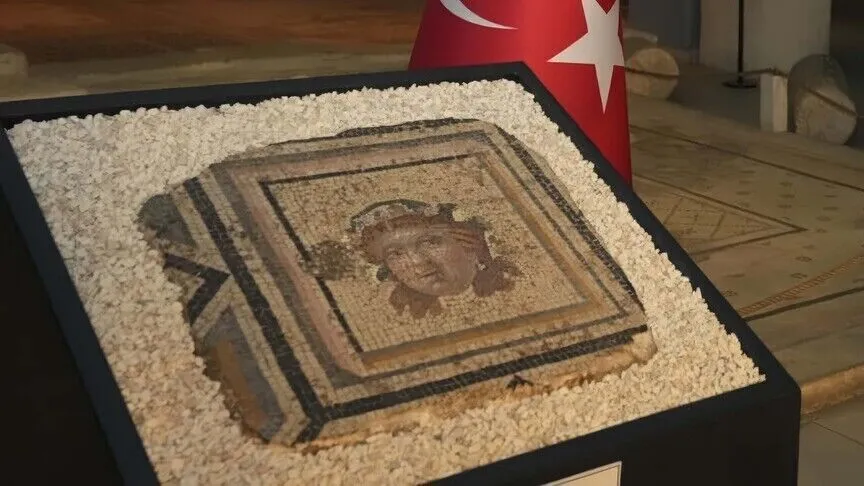
The eyes reach you first. A young face laid in tiny stones, hair tousled, one gold earring, a look thrown sideways that seems to follow you across the room. The archaeologists who lifted her from the ground called her the Gypsy Girl, the Mona Lisa of Zeugma, and for years she watched over the museum in Gaziantep with parts of her own picture torn away.
On 14 July, one of those parts came back. Culture and Tourism Minister Mehmet Nuri Ersoy handed the 13th panel of the mosaic composition to the Zeugma Mosaic Museum at a ceremony in Gaziantep, returned from the United States and set back among the fragments it was cut away from generations ago.
It is a small tile of a much larger story. The 12 panels that frame the Gypsy Girl composition were already home. They came back in 2018 from Bowling Green State University in Ohio, which had held them for decades before Turkish and American scholars established that they belonged to Zeugma, not to Antioch as the university had long believed. This new arrival makes 13.
How the panel was traced
Ersoy walked the room through the recovery, and it is worth keeping the account as his. The trail began with scholarship. Dr. Camila Felag of Grenoble Alpes University in France and Prof. Kutalmış Görkay, who directs the Zeugma excavations, matched the loose panel to the Gypsy Girl composition and tied it to the rest of the picture.
Then the ministry asked US authorities where the piece was. That first inquiry stalled; Türkiye was told the buyer could not be reached. So its experts kept watching the sale rooms. When the panel surfaced again, relisted at auction, Ankara renewed its claim with the scientific file behind it. A case run by US Homeland Security Investigations did the rest, and the work was sent back.
Ersoy tied the outcome to a memorandum Türkiye and the United States signed in 2021 against the trafficking of cultural property. He said the agreement, applied in five-year terms, has now been extended for another five years. By separate accounts of the handover, the panel passed through the Turkish Consulate General in Chicago and flew home in the hold of a Turkish Cargo plane.
A face broken up on the Euphrates
Zeugma sat where it did for a reason. The ancient city straddled a crossing point on the Euphrates in what is now Gaziantep province, a Roman garrison and trading town rich enough to floor its villas with mosaic. The Gypsy Girl herself dates to the 2nd and 3rd centuries A.D., worked in the fine, close-set tesserae that let an artist model a cheekbone or a glance almost like paint.
Nobody agrees on who she is. The name is a modern nickname coined at the dig, not an identification, and scholars have read the face as a maenad, as Gaia, even as Alexander the Great. The mystery is part of why she draws crowds. The museum that holds her, opened in 2011, has counted more than two million visitors and ranks among the largest mosaic museums in the world.
Her scattering came earlier, and it was crude. The panels around the central face were pulled out by illegal digs in the 1960s and fed onto the market, one broken picture sold off in pieces. Some of those pieces crossed the Atlantic. Recovering them has taken decades, a change in US law and attitude, and the patient work of matching a stray tile to the composition it was carved from.
Ersoy framed the homecoming in those terms. He put Türkiye's recoveries at 13,454 artifacts since 2002, a running tally that treats each return less as an event than as one more entry in a long ledger. His phrasing at the ceremony was plainer. Bringing the missing pieces back, he said, completes a mosaic and repairs a damaged memory in the same motion.
That is the quiet argument under a story like this one. A looted object leaves two holes, one in the picture and one in a place's account of itself. The Gypsy Girl has 13 of her panels back now. She is still short of whole, and the museum in Gaziantep is still watching the sale rooms.