On 23 July 1919, in Erzurum, a former Ottoman general who had resigned his commission weeks earlier was elected to chair a congress. Mustafa Kemal held no army and no government post. Two weeks later, when the delegates went home, he had something more durable than either: a set of principles that would eventually carry the country from a defeated empire to a republic.
The First World War had ended the autumn before, and it had ended badly. The Armistice of Mudros in October 1918 left the Ottoman state prostrate, its army stood down, its capital under Allied watch, its territory exposed to occupation and to competing partition plans. By the summer of 1919 the choosing had begun. Greek troops had landed at İzmir in May. Allied plans circulated to carve Anatolia into zones and to cut the eastern provinces loose from the state entirely. It was in the east, where the threat was nearest, that the answer took shape first.
The Erzurum Congress ran from 23 July to 7 August 1919. It was called by the Society for the Defense of the Rights of Eastern Anatolia, joined by the rights society of Trabzon, and it gathered roughly 62 delegates from the provinces most exposed: Erzurum, Trabzon, Sivas, Bitlis, and Van. On paper it was a regional gathering about a regional danger. In substance it was national.
For Mustafa Kemal, the timing was everything. He had been sent to Anatolia in May as an army inspector, then resigned his commission in early July rather than be recalled to İstanbul. That left him a private citizen. The congress presidency, which the delegates handed him by a unanimous vote, restored his political legitimacy, an elected footing rooted in the country rather than the palace. The Diyanet's İslâm Ansiklopedisi records the vote; Britannica notes that the chairmanship is where he "gained official status." It was the first office of the new movement, and he held it.
The decisions were plain and they were firm. The homeland within its national borders is a whole and cannot be divided. If the government in İstanbul proved unable to resist occupation and intervention, the nation would defend itself. Mandate and protectorate, the idea that Türkiye might be run under the tutelage of a foreign power, were rejected outright. No concession that harmed the nation would be granted. The national forces, the Kuva-yı Milliye, answered to national unity. And to see the principles through, the congress formed a nine-member Representative Committee, the Heyet-i Temsiliye, with Mustafa Kemal at its head, a body that would soon act as the movement's de facto executive.
For all its defiance, the congress was not yet republican. Its stated aim was to save the Ottoman state and the sultanate-caliphate from partition, not to replace them; the Republic was four years and a war away. But the resolutions it passed became the founding charter of the national movement, and everything that followed built on them.
Read the phrases against the map of 1919 and the boldness is clear. An occupied, disarmed state, its capital shadowed by Allied fleets, declared through a congress in a far eastern city that its borders were not up for negotiation and that it would take no one's tutelage. Atatürk himself, years later in his great speech, the Nutuk, treated Erzurum as the moment the line was drawn.
The line held because it traveled. Four weeks after Erzurum closed, the Sivas Congress of September 1919 widened the same principles from the east to the whole country and kept Mustafa Kemal at the head of an enlarged Representative Committee. The following January, the last Ottoman Parliament adopted the Misak-ı Millî, the National Pact, the territorial creed of the independence struggle. Many of the principles first voiced at Erzurum reappeared in it. From there the road runs to the Grand National Assembly in Ankara in 1920 and the Republic in 1923.
That is why the anniversary still gets marked from the top. In his message on 23 July, President Erdoğan called the congress one of the turning points where the nation gathered around a shared ideal, and singled out the members who declared the homeland whole and refused mandate and protectorate outright. The words he chose to quote were the congress's own.
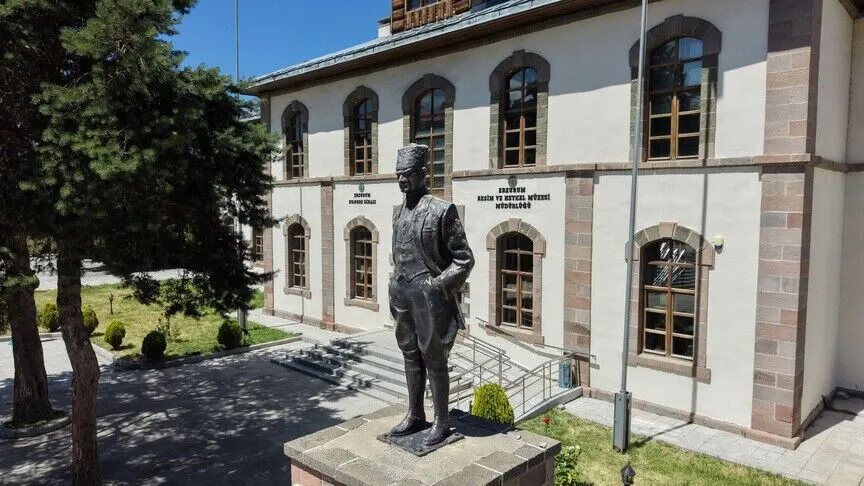
A century on, the building where they met is a museum, and the sentences written in it have hardened into something close to national scripture. But in the summer of 1919 they were a wager, made by delegates from five threatened provinces and a general with no army, that a country written off by the people carving up its map would decide its own borders. They were right, which is the only reason we remember that they were bold.