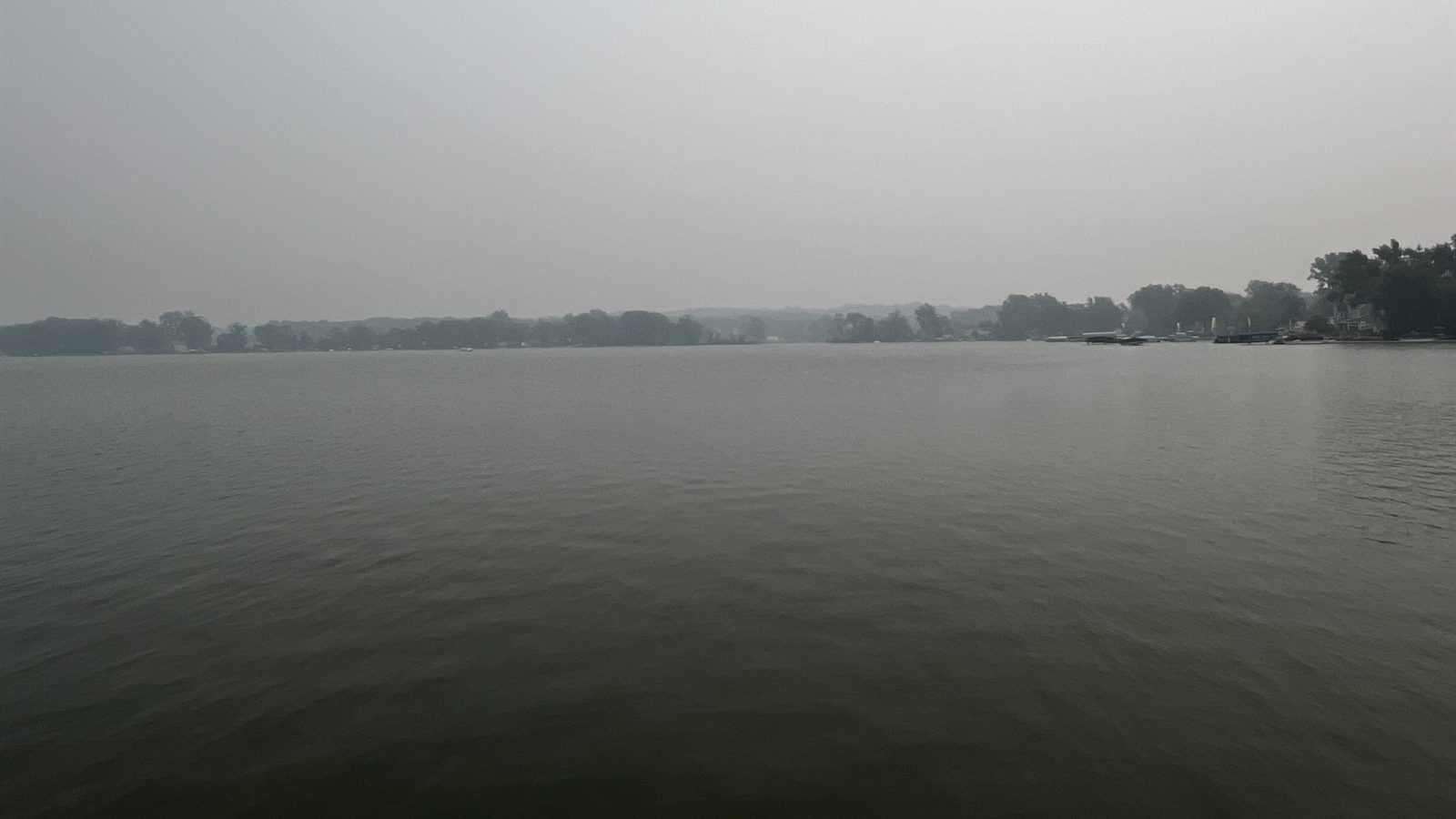
For much of this week Toronto held the worst air of any major city on earth, ranked above Delhi and Kinshasa on the live pollution indexes, its skyline flattened into an orange smear by smoke from more than 800 wildfires burning across Canada. By Thursday that smoke had crossed the border and settled over Michigan, Minnesota and the wider Great Lakes, with air-quality alerts running east into New York and New England.
The scale on the Canadian side is hard to hold in the mind. Canadian agencies count roughly 3,500 fires this season, which have burned more than 1.9 million hectares (about 4.8 million acres), and northern Ontario alone had close to 200 still active, Al Jazeera and CTV reported. Ontario has logged 453 fires so far this year against 349 by the same point in 2025, well above its ten-year average. One community, the Collins First Nation, was reported destroyed by a fast-moving blaze, and the Chiefs of Ontario pressed the federal and provincial governments for a faster response as evacuation orders spread.
South of the border the story was smoke rather than flame. The US Environmental Protection Agency and NOAA rated stretches of the Upper Midwest and Great Lakes "unhealthy" to "hazardous," the top of the index, and residents from Toronto to Boston were told to keep children indoors and skip strenuous activity outside. CNN and NASA tracked the plume as it thinned southward, reaching as far as Mexico. None of this is new to a North American summer anymore. The smoke season now arrives on schedule.
The smoke has since found the biggest stage in the country. Air-quality alerts stretched across the New York area ahead of Sunday's World Cup final, an open-air match at MetLife Stadium in New Jersey, Argentina against Spain, expected to draw more than 80,000 people. FIFA said the game would go ahead, its officials monitoring the air while forecasters hoped a storm on Saturday would clear the sky in time.
Türkiye knows the pattern from the inside. As Canada's smoke drifted over the lakes, Turkish crews were fighting their own fires across the Aegean and Marmara provinces, with blazes reported this week in İzmir, Manisa and Muğla, and further north in Balıkesir and Bursa, several of them started in stubble fields before jumping to forest. Sözcü reported the Manisa and Muğla fires brought under control after long shifts by ground teams and water-bombing aircraft. The fires kept coming. Days later, crews were still working fresh blazes in İzmir's Narlıdere district and in Tavşanlı, in the inland province of Kütahya, according to Anadolu Ajansı. By early July the country had lost close to 50,000 hectares (about 124,000 acres) to fire for the year, according to Daily Sabah, and the General Directorate of Forestry has kept an unusually large fleet in the air, 28 firefighting planes, 119 helicopters and 14 drones among them, with more trucks on order.
Most of those fires trace back to people. The Agriculture and Forestry Ministry used the season to remind the public what starting one costs, posting on social media, and relayed by Anadolu Ajansı, that negligence leading to a forest fire carries up to 10 years in prison, deliberate arson carries a life sentence, and even burning stubble near woodland can bring one to three years. It is a country that has learned, over a run of punishing summers, how much a single dropped cigarette or an out-of-control field fire can cost in pine.
Both continents are burning under the same season. Meteorologists tie it to heat and drought layered on a warming baseline, the conditions that turn ordinary fire weather into records, and 2026 is shaping into one of those years on several continents at once. Toronto's air will clear when the wind shifts and the fires ease. The conditions that filled it are the part that does not move on.