Obsidian is volcanic glass. It forms when lava cools too fast to crystallize, and it fractures into edges of extraordinary sharpness, which is why people who had no metal wanted it badly enough to move it across water.
The Aegean's best-known prehistoric source is Melos, a small volcanic island in the Cyclades. Blades struck from Melian obsidian turn up all over the prehistoric Aegean, and their distribution is one of the ways archaeologists trace who was in contact with whom before anyone wrote anything down.
This summer a piece of it came out of the ground on a mountain pasture in Muğla, about 100 kilometers (62 miles) from the sea and 1,287 meters (4,222 feet) up, in a layer laid down around 2400 BC.
A mound on the summer grazing
Çaltılar Höyük sits on the Seki plateau in the Fethiye district, in the upper reaches of the Xanthos river system, the modern Eşen Çayı. The ancient cities of Balboura and Oinoanda are its neighbors. This is northern Lycia, high and cold in winter, the kind of country people have historically used as yayla, the summer pastures you climb to when the lowlands turn to dust.
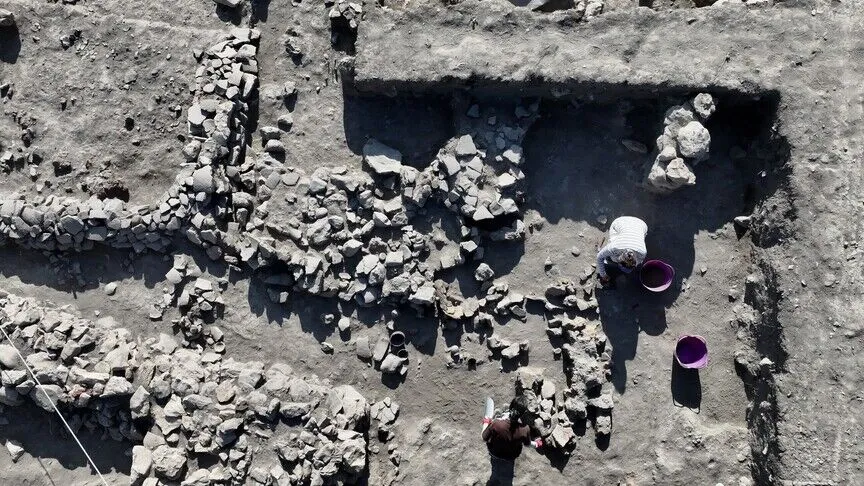
Hacettepe University has been digging there since 2021, under Ayşegül Aykurt, as part of the Culture and Tourism Ministry's Heritage for the Future project. The mound has produced layers running from the Late Chalcolithic through the Early, Middle and Late Bronze Ages into the Archaic period. Anadolu Ajansı reports eight occupation layers between about 3100 and 2400 BC alone.
The first settlers did not build on the mound at all. They lived out on the plain beside a marsh, and moved up only when the marsh dried out, around 5,100 years ago.
Writing in the Turkish Academy of Sciences journal of archaeology last year, Aykurt and Kadir Böyükulusoy described the Late Chalcolithic settlement as four architectural layers of wattle and daub, pisé and timber. Mud, sticks and rammed earth, rebuilt on itself for centuries.
The problem with Bronze Age Lycia
There is a long-standing awkwardness about this region, and the obsidian speaks to it.
The documentary record has plenty to say about the Lukka, a people who appear repeatedly in Bronze Age texts and are generally connected with the Lycians of later antiquity. The ground has had very little to say back. Second-millennium archaeology in southwest Anatolia is conspicuously thin, and excavated mounds in the region are scarce.
A place like Çaltılar earns its attention by being stratified, continuously occupied, and sitting exactly where the documents insist something ought to be.
An international team surveyed the mound between 2008 and 2010, led by Nicoletta Momigliano of the University of Bristol, and published the results in the British Institute at Ankara's journal Anatolian Studies in 2011. They found the site had been occupied from at least the fourth millennium BC down to the middle of the sixth century, a date coinciding with the Persian conquest of Lycia, with only scant evidence of use afterwards.
Their conclusion about its connections was carefully worded, as it had to be. Despite the site's position in the summer pastures and its considerable altitude, they wrote, it appeared "well-connected to other Anatolian and Aegean regions," and probably served as "more than just a minor seasonal agro-pastoral settlement," particularly during its Early Bronze Age and Late Iron Age occupations.
On the second millennium they were blunter about what they did not have. The evidence was "too limited at present to allow further interpretation," they wrote, but significant in itself, given how scanty the remains of that period are in the region, "and despite the numerous references to the Lukka people and settlements available in documentary sources."
That is a survey team saying, in the register the discipline requires, that they think this hillside was connected to the wider world and cannot yet prove it.
What the 2026 season put in the tray
Chipped stone tools made from Melian obsidian, according to Aykurt, who told Anadolu Ajansı that the find "demonstrates the settlement's overseas connections."
Note the date before reading too much into it. This is third-millennium material, a thousand years earlier than the Lukka appear in the documents. It speaks to the connections the survey team suspected, not to the silence around Bronze Age Lycia's most famous absentees.
Alongside the blades, a fragment of a Cycladic frying pan, one of the flat, long-handled clay objects that are among the most recognizable products of the Early Bronze Age Cyclades. And a spool-shaped weight of a type associated with the western Aegean.
Then the detail that makes the rest of it interesting. In the same archaeological layer, tools made from obsidian sourced to central Anatolia.
Two volcanic glasses, from opposite directions, in one layer, on a mountain pasture. The Aegean came up the valley and the plateau came down it, and this settlement was handling both.
Aykurt suggested the inhabitants may have built their overseas contacts through trade along the Eşen. That river runs south to the Mediterranean rather than west to the Aegean, so a Cycladic object arriving here had already made a coastal journey before it started climbing.
The part that does not fit
The excavation has also turned up ceramics from Lycia, Caria, Lydia and Ionia, and an Archaic structure whose stone foundation incorporates fragments of Late Bronze Age burial jars. Aykurt said no comparable example has been found in Anatolia so far.
She was careful about what it all adds up to, and her caution is worth repeating rather than smoothing away. The diversity of the finds, she said, does not correspond with the site's architecture. The buildings look like what they are, a highland village of mud and timber. The objects inside them do not.
Her suggestion is that the people living there may have been connected to, or under the influence of, some power that controlled the regions those materials came from. She offered it as a possibility, and it should be read as one.
The glass itself is beyond dispute. A piece of a Cycladic volcano, carried across water, up a river valley and onto a mountain pasture, and dropped in a village whose houses were made of sticks and mud, four and a half thousand years ago.